Burger King App Promo Codes: A Practical 2026 Savings Workflow
Burger King app promo codes look simple until you are standing in a parking lot, hungry, trying three offers that all fail for different reasons. One code is expired. One only works at a different location. One drops the reward you already had in your cart. The discount is real, but the workflow is bad.
Teams think the problem is finding a code. The real problem is proving the final total before you commit to the order.
That changes the conversation. You are not just hunting for a magic string of characters. You are managing a small checkout system: app offer, account state, restaurant location, menu eligibility, pickup or delivery mode, taxes, fees, and timing.
The practical question is not “Where can I find Burger King app promo codes?” It is “How do I test offers quickly, avoid dead codes, and know when the deal is actually better than the menu price?” This guide treats couponing like an operating workflow, because that is what keeps you from wasting time.
Table of contents
- Why Burger King app promo codes are a workflow problem
- Where Burger King app promo codes actually show up
- Build a pre checkout savings checklist
- The practical Burger King app promo codes workflow
- Compare app offers promo codes and third party delivery deals
- Stacking rules exclusions and order design
- Failure modes that waste time and money
- What works for repeat Burger King savings
- What fails when deal hunting becomes random
- A simple 2026 workflow for families groups and commuters
- Use a community coupon workflow not random code hunting
Why Burger King app promo codes are a workflow problem
The code is only one input
The mistake teams make is treating a promo code like the whole deal. Shoppers do the same thing. They copy a Burger King code, paste it into the app, and assume the job is done.
In practice, the code is only one input. The final price depends on the order contents, the restaurant you selected, the fulfillment method, your account, the reward already attached, and sometimes the time of day. A code that works for a Whopper meal may not work for a limited-time item. A free delivery promo may not help if pickup is already cheaper. A reward might beat a percentage discount on a small cart.
A useful way to think about it is this: the app is a rules engine, not a coupon drawer. Your job is to put the right cart into the rules engine and compare the outcome.
Practical rule: Never judge a Burger King app promo code by the discount wording. Judge it by the final checkout total after tax, fees, and reward conflicts.
Why the app changes deal timing
Paper coupons were simple because the decision happened at the counter. App offers are different. The decision happens before the order is submitted, and small changes can reset the total.
That matters because fast food orders are usually time-constrained. You are not doing a calm spreadsheet exercise. You are in a lunch break, in a car, with a kid asking for fries, or trying to coordinate a group order. If the workflow requires ten minutes of testing, it will fail.
The practical question is how to reduce the test loop. You want a fast sequence: build cart, apply offer, verify total, compare backup, order. Anything else becomes coupon theater.
What breaks when you rush
What breaks in practice is not usually the existence of a discount. It is the handoff between the deal and the checkout. You forget to switch the store location. You add a substituted item and the code drops. You assume delivery is included, then service fees erase the savings. You redeem points on the wrong item and cannot reuse them immediately.
Rushing also makes bad comparisons look good. A $5 discount is not automatically better than a built-in app meal bundle. A free item is not automatically free if it pushes you into a larger cart than you planned.
Related reading from our network: privacy-focused app users face a similar workflow problem where the feature is less important than how people use it day to day, as covered in secure messaging apps in 2026.
Where Burger King app promo codes actually show up
In app offers and rewards
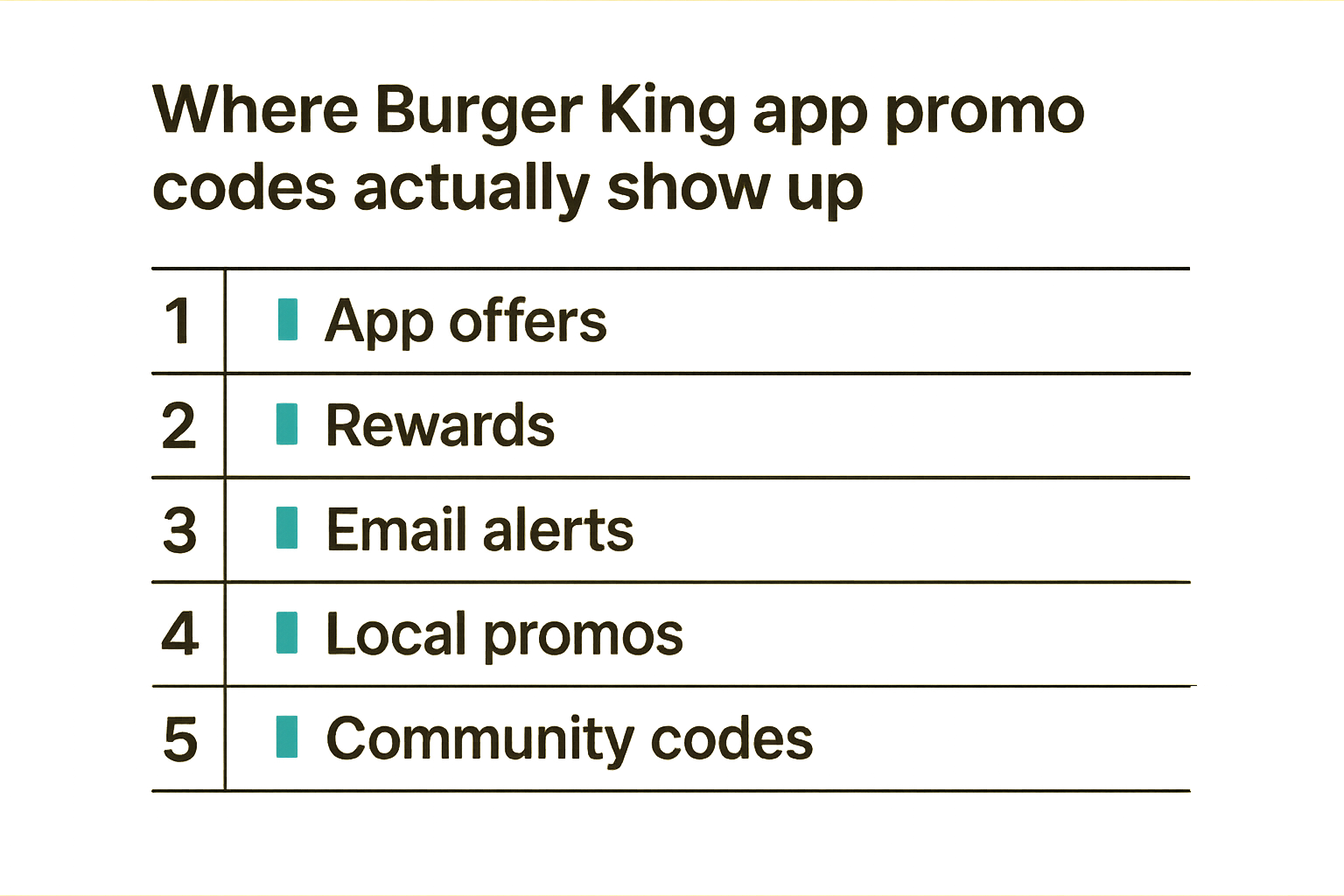
The most reliable place to start is inside the Burger King app itself. App offers are usually tied to your account and are easier to validate because the app can immediately show whether the cart qualifies. Rewards points, limited-time offers, and account-specific deals may all appear in the same area, but they do not behave the same way.
Some offers are click-to-apply. Some require adding a specific menu item. Some are better treated as meal design constraints: if the offer is for a sandwich, build around that sandwich rather than building a normal cart and hoping the discount fits.
The mistake teams make is checking the offer list after the cart is already built. For Burger King app promo codes, reverse that order when you can. Scan available offers first, then build the cart around the strongest one.
Email push and local store promos
Email and push notifications can be useful, but they are noisy. They often tell you that an offer exists without making the eligibility rules obvious. Local promos can also vary by restaurant, region, and time window.
If you see a promo in email, do not assume it applies to your selected store. Open the app, select the exact restaurant, and recreate the cart. The app checkout is the source of truth for the order you are about to place.
This is where deal hunters lose time. They remember a notification, open the app later, and cannot find the offer. That may mean the promo expired, the selected store changed, or the offer was account-specific. It does not always mean the deal was fake.
Community coupon pages and deal threads
Community coupon pages help because they capture real shopper outcomes. A code that worked for someone today is more useful than a stale code copied across ten coupon sites. But even community-submitted deals need validation.
When you search outside the Burger King app, prioritize recency, comments, and context. A useful submission says what worked, when it worked, and what cart type it worked on. A weak submission only says “20% off” with no checkout proof.
For broader code discovery, you can use community coupon search to compare recent submissions and avoid relying on one random code snippet from a search result.
Build a pre checkout savings checklist
Start with the cart not the code
A coupon workflow starts with the cart because the cart defines the value of the code. If you planned to buy one sandwich, a family bundle discount may be irrelevant. If you planned to buy four meals, a free small item may be noise.
Before testing Burger King app promo codes, write down the order you actually want. Not the fantasy order. Not the order required by a promo. The real order. Then create one alternate cart that you would be happy with if the discount is strong enough.
That gives you two baselines:
- Your intended cart without a promo.
- Your deal-optimized cart with the promo.
Now you can compare like an operator instead of reacting to discount language.
Check pickup delivery and location rules
Pickup and delivery are different price environments. Delivery may include higher item prices, service fees, delivery fees, and driver tips. A promo code can be technically valid and still not be the cheapest option.
Location matters too. A Burger King franchise may not support every app offer, or the menu item may be unavailable at that store. If you move from one store to another, retest the code. Do not assume the cart state remains valid.
Practical rule: If you change store, fulfillment method, or major menu item, retest the promo from scratch. The previous discount state is no longer reliable.
Keep backup offers ready
Do not test one code at a time with no fallback. That is how checkout becomes frustrating. Keep two backup options:
- A built-in app offer that does not require a typed code.
- A rewards redemption or lower-cost menu swap.
Your backup does not need to be perfect. It just needs to prevent a failed promo code from turning into full-price checkout by default.
A good coupon workflow has an exit path. If the code fails, you know the next best move. If the backup is weak, you know to skip the order or change the meal.
The practical Burger King app promo codes workflow
Step by step testing sequence
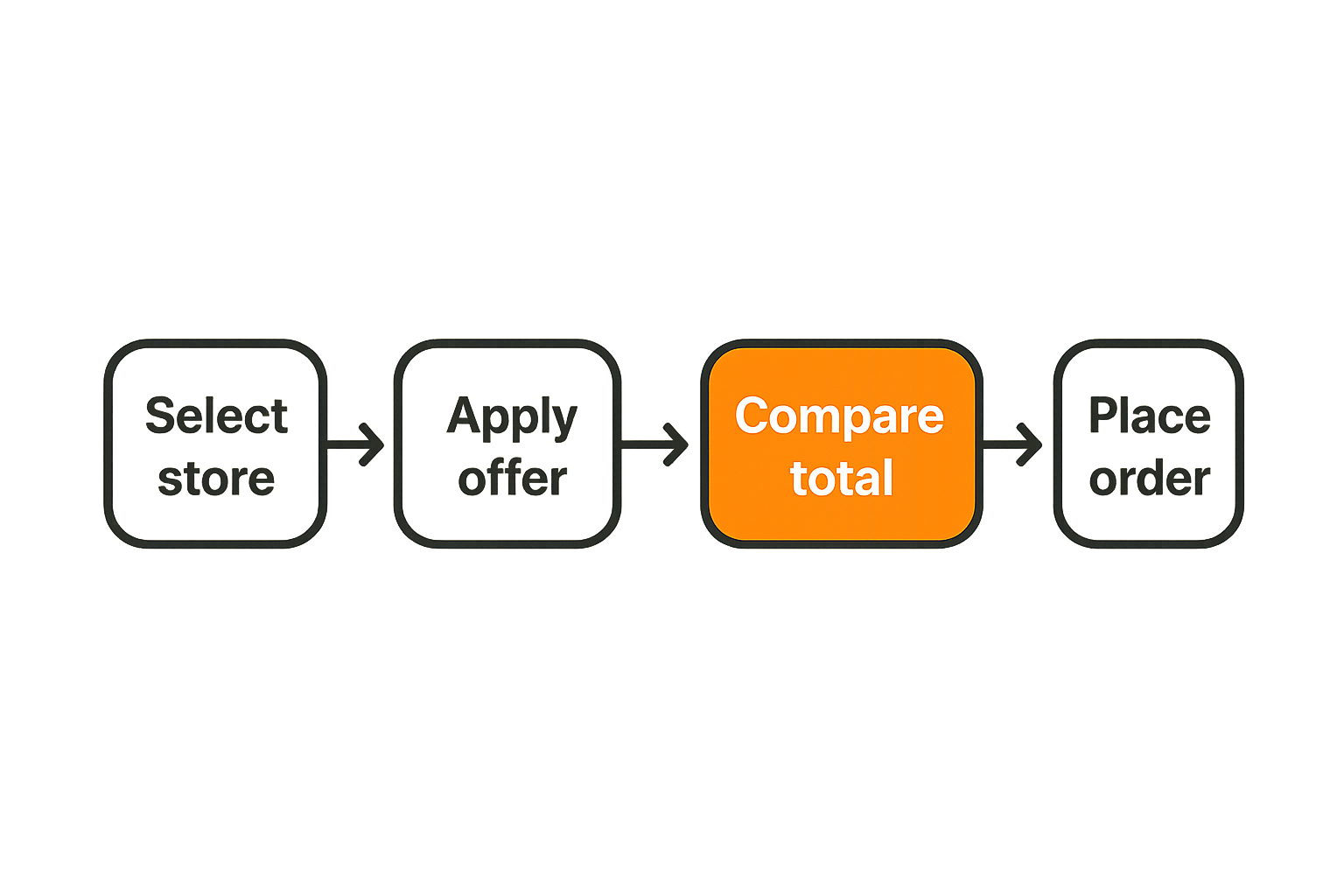
Here is the workflow I would use in 2026 for Burger King app promo codes. It is deliberately simple because complicated coupon systems collapse in real life.
- Open the Burger King app and sign in before building the order.
- Select the exact restaurant you plan to use.
- Choose pickup or delivery and do not switch modes mid-test unless you restart the comparison.
- Review in-app offers and rewards first.
- Build your intended cart without applying a code.
- Note the subtotal, taxes, fees, and final total.
- Apply the strongest app offer or promo code.
- Check whether any item was removed, changed, or made ineligible.
- Note the new final total, not just the discount line.
- Test one backup offer if the first result is weak.
- Choose the lowest acceptable final total for the food you actually want.
- Place the order only after the total is stable.
This sounds like a lot, but the loop is fast once you do it twice. The point is not to overthink lunch. The point is to avoid paying more because a discount headline distracted you from the final price.
What to record before paying
You do not need a spreadsheet for every burger. But for repeat savings, record the few details that help you improve the next order:
- Date and approximate time.
- Store location or region.
- Pickup versus delivery.
- Offer or code tested.
- Cart type that qualified.
- Final total before and after.
- Any exclusions or conflicts.
This is especially useful for families or commuters who use the same locations repeatedly. Patterns appear quickly. One store may support more offers. One cart structure may consistently trigger better value. One delivery promo may never beat pickup.
The earlier c0upons guide to Burger King app promo codes covers a similar checkout-first approach; the point here is to make that workflow repeatable instead of treating each order like a new hunt.
When to abandon a code
Not every code deserves another test. Abandon the code when any of these happen:
- The app says the code is expired.
- The code requires items you do not want.
- The discount disappears after normal edits.
- The offer saves less than a simpler app deal.
- Delivery fees erase the promo value.
- You have to increase the cart just to qualify.
The mistake shoppers make is trying to “rescue” a code. They add food, switch stores, change fulfillment mode, and spend ten minutes chasing a discount that is no longer connected to the original purchase.
Practical rule: A promo code that forces you to buy more than you planned is not a discount until the final total beats your original cart.
Compare app offers promo codes and third party delivery deals
The tradeoff table
Burger King savings usually come from three places: in-app offers, typed promo codes, and third-party delivery platform deals. None is always best. The right choice depends on cart size, pickup ability, fees, and timing.
| Deal source | Best use case | What works | What fails |
|---|---|---|---|
| Burger King app offer | Pickup orders, rewards users, simple meals | Fast validation inside checkout | May be location-limited or one-off |
| Burger King app promo code | Specific campaigns or account offers | Can beat standard offers when eligible | Often has exclusions or expiration rules |
| Rewards redemption | Small carts or frequent buyers | Good when points cover a high-value item | Can conflict with other offers |
| Third-party delivery promo | Delivery-only situations | Useful when platform discount beats fees | Service fees and menu markups can erase savings |
| Menu bundle or value item | No valid code available | Predictable and simple | Less exciting than a promo but often cheaper |
The table is not a ranking. It is a decision tool. If you can pick up the order, the Burger King app often gives you the cleanest checkout. If you cannot pick up, delivery promos deserve a separate comparison because the cost structure changes.
Related reading from our network: the same architecture-first thinking shows up in technical buying decisions, where routing and validation matter more than headline claims, as discussed in cloud computing companies in 2026.
When app pickup wins
App pickup wins when the discount is easy to apply, the store is nearby, and the cart is not inflated by delivery costs. It also gives you more control. You can verify the restaurant, review item availability, and avoid platform-specific markups.
For budget-conscious shoppers, pickup is often the cleanest baseline. Even if a delivery app advertises a larger promo, the final total may include service fees, delivery fees, and a tip. Those are real costs. They belong in the comparison.
A useful way to think about it is to compare complete order cost, not discount size. A $3 app offer on pickup may beat a $7 delivery promo if the delivery stack adds $9 in extra costs.
When delivery platforms make sense
Delivery platforms make sense when you were going to pay for delivery anyway, when the platform promo is unusually strong, or when time matters more than the last dollar saved. That is a valid tradeoff. The goal is not to shame convenience. The goal is to price it honestly.
If you compare Burger King app promo codes against delivery deals, build both carts at the same time and compare final totals. Do not compare an app subtotal to a delivery final total. That is a bad measurement.
The practical question is simple: “What am I paying to receive this food in this way?” Once you frame it like that, the better deal is usually obvious.
Stacking rules exclusions and order design
Common stacking limits
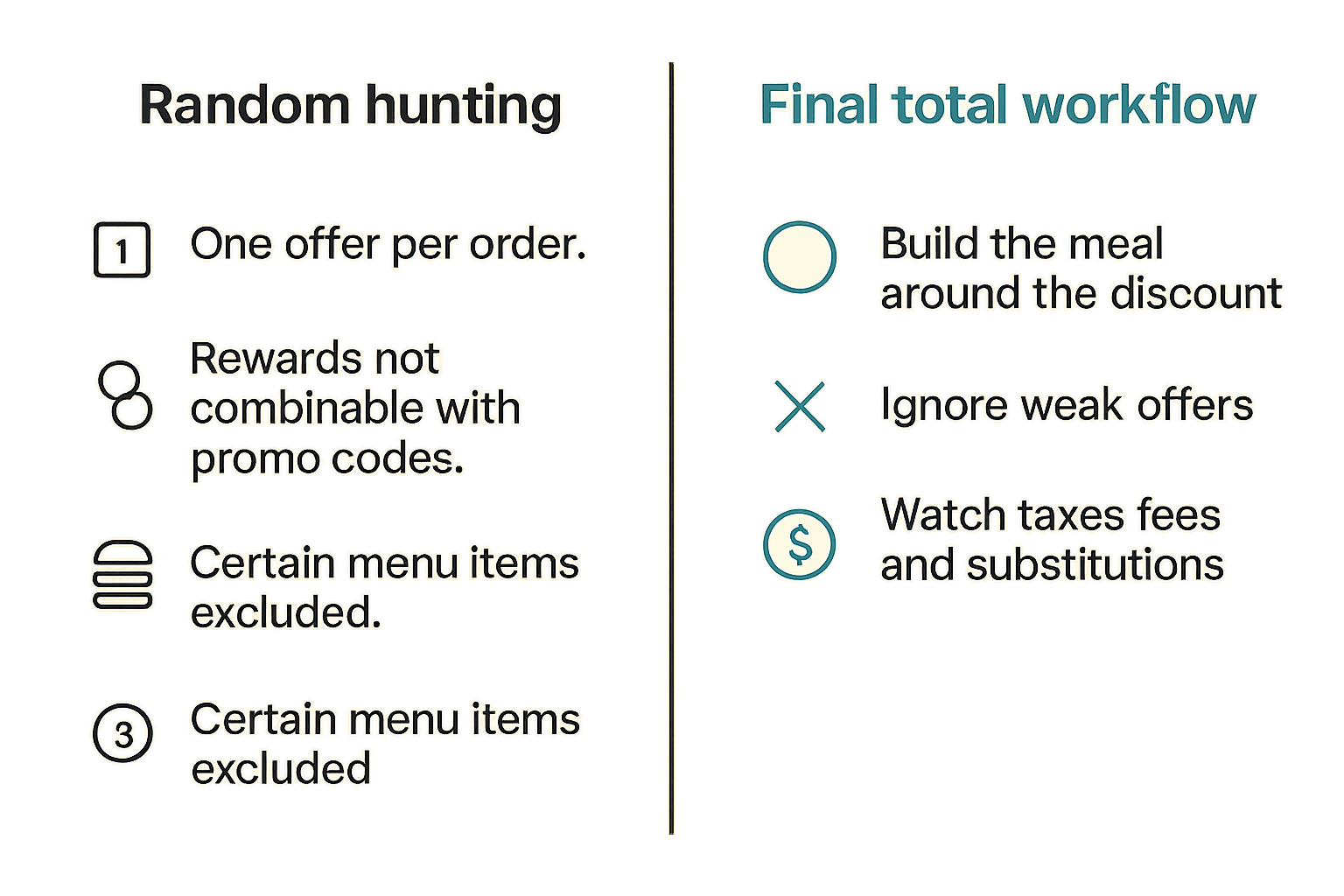
Stacking is where many Burger King app promo codes become confusing. Shoppers want to combine a promo code, a reward, a meal bundle, and a payment offer. Sometimes one or two can coexist. Often they cannot.
Common limits include:
- One offer per order.
- Rewards not combinable with promo codes.
- Certain menu items excluded.
- Delivery-only or pickup-only language.
- Minimum purchase requirements.
- Account-specific eligibility.
- Time-limited windows.
The app may not explain every rule in plain language. Sometimes it simply refuses the code or removes a previous discount. That is why you need a test sequence, not assumptions.
Build the meal around the discount
If an offer is strong, design the order around it. If it is weak, ignore it and use your normal cart. The worst middle ground is forcing your cart to match a mediocre deal.
For example, a discount on a premium combo may be useful if you wanted that combo anyway. It is less useful if you planned to spend less and now need to upgrade. A free side may be useful for a family order. It may be irrelevant for a solo order where you already have enough food.
Order design is not about maximizing the sticker discount. It is about minimizing the amount you pay for the meal you actually want.
Watch taxes fees and substitutions
Taxes and fees can make the discount line misleading. So can substitutions. If you swap an item, add cheese, change size, or remove a required component, the offer may change. Some customizations increase the price even while the promo remains active.
The final total is the only number that matters. If the discount saves $4 but customizations add $3.50, you saved fifty cents. That may still be fine, but it is not the deal you thought you were getting.
Practical rule: After any cart edit, scroll back to the final total. Do not trust the previous discount line to survive the edit unchanged.
Failure modes that waste time and money
Expired codes that still circulate
Expired codes are the normal state of the coupon internet. A code can live for months after it stops working because old pages, screenshots, and social posts keep circulating. That does not always mean someone is acting in bad faith. It means coupon content has a long shelf life and app rules change faster than search results.
The fix is recency. Prefer codes with recent verification, recent comments, or current app visibility. If a code has no date context, treat it as unproven.
This is why community maintenance matters. When shoppers report whether a Burger King code worked or failed, everyone else gets a shorter test loop. If you find a working or dead offer, you can submit coupon details so the next shopper has better context.
Location and franchise mismatch
Burger King locations may vary in participation, item availability, pricing, and app behavior. A code that works in one city may fail in another. A store that accepts an offer today may not show the same menu tomorrow.
The practical fix is boring but effective: select the location first. Do not build a cart under one restaurant and switch later unless you are willing to retest. Location is not a cosmetic field. It is part of the discount rules.
If you are traveling, assume your usual pattern needs validation. Road trips are where coupon assumptions break because you are changing region, store, inventory, and timing all at once.
Reward conflicts and account issues
Rewards create another failure mode. You may have points, account offers, birthday offers, or targeted promos. These can conflict with typed codes or other app deals. Sometimes the app chooses one discount automatically. Sometimes you need to remove one before applying another.
Account state also matters. If you are logged out, using a new account, or switching devices, the offers shown may differ. If a code seems to disappear, confirm you are in the right account before assuming the promo is gone.
Related reading from our network: incident-response teams deal with similar ownership and handoff problems when signals move across systems, which is the angle in CHP traffic incident thinking for SOC response.
Checkout drift after edits
Checkout drift is the quiet killer. You apply a code, see a good total, then make “one small change.” The total changes, but you do not notice. Maybe the offer dropped. Maybe the item price changed. Maybe a fee appeared.
This is common with group orders. Someone changes a drink size or swaps an item after the promo is applied. The order still looks discounted, but the final total is no longer the one you approved.
The fix is a final checkpoint: before payment, confirm the exact final total and the active discount. Not the subtotal. Not the cart preview. The final payable amount.
What works for repeat Burger King savings
Use a weekly review rhythm
Many teams improve systems by reviewing the last few runs. Shoppers can do the same without making it complicated. If you order Burger King regularly, review offers once a week instead of starting from zero every time.
Look for patterns:
- Which store usually has the best app compatibility?
- Which offers repeat?
- Which cart sizes get the best value?
- Which codes fail often?
- Which days or times produce better app deals?
You are not trying to become a professional analyst. You are building memory. The more repeatable your pattern, the less time you waste at checkout.
Separate cravings from deal decisions
A deal is only a deal if it fits what you wanted or a substitute you are happy with. If you wanted a simple sandwich and the promo pushes you into a bigger meal, pause. The offer may be doing its job for the restaurant, not for your budget.
This is the core discipline of fast food savings: decide what you want before the promo starts negotiating with you. Then let the promo reduce the cost, not rewrite the order.
That changes the conversation. Instead of asking “How much can I save?” ask “What is the lowest price for a meal I actually want today?”
Share verified outcomes
Coupon communities work when people share outcomes, not just codes. A useful report is specific:
- “Worked today for pickup.”
- “Failed on delivery.”
- “Required $10 minimum.”
- “Only worked with selected store.”
- “Did not stack with rewards.”
This kind of detail reduces noise. It also helps shoppers avoid repeating the same failed tests. General deal chatter is fine, but verified checkout context is what saves time.
What fails when deal hunting becomes random
Chasing every code
Random code chasing feels productive because you are doing something. In reality, it often creates more friction than savings. You copy codes from old posts, test them without a baseline, and lose track of which cart was cheapest.
The practical limit is two or three tests. If the first strong code fails and the backup is weak, stop. Use the best app offer, switch to a value item, or skip the purchase. The goal is savings, not completion of a coupon scavenger hunt.
Ignoring final total
The most common failure is judging the deal by the discount label. “$5 off” sounds better than “free fries” until you compare the complete order. “Free delivery” sounds good until service fees and menu markups appear.
A coupon workflow without final-total comparison is not a workflow. It is guessing.
For adjacent savings habits beyond one restaurant, the c0upons community blog publishes practical deal guides that focus on checkout behavior rather than hype around big discount claims.
Treating screenshots as proof
Screenshots can help, but they are not proof that your order will qualify. They may come from a different account, region, store, date, or cart. Treat screenshots as leads, not guarantees.
Better proof is reproducibility. Can you select your store, build your cart, apply the offer, and see the final total before paying? If yes, the deal is real for your purchase. If not, it is just information.
A simple 2026 workflow for families groups and commuters
Family order pattern
Family orders are where Burger King app promo codes can matter most because the cart is larger. But larger carts also create more failure points. One excluded item can break an offer. One substitution can change the economics.
For families, use this pattern:
- Build the normal family cart.
- Save or remember the final total.
- Check offers that apply to bundles, meals, or minimum spend.
- Remove low-value extras if they were added only to qualify.
- Compare the final total against the original cart.
The mistake is adding food to reach a threshold without checking whether anyone wants it. If you spend $6 more to save $5, you did not save money.
Lunch break pattern
Lunch breaks require speed. You need a shorter workflow:
- Open the app before leaving.
- Select the store near work.
- Check one app offer and one reward option.
- Compare against your normal low-cost order.
- Order only when the final total is clear.
Do not run a ten-code test during lunch. It will frustrate you and may push you into a rushed full-price order. For lunch, reliability beats theoretical maximum savings.
Road trip pattern
Road trips are different because location changes constantly. Your usual store knowledge does not apply. Before relying on a code, confirm the restaurant, menu availability, and pickup timing.
For road trips, the best strategy is to keep the order simple. Use visible in-app offers, avoid complicated stacking, and compare pickup against drive-thru convenience. If the app is slow or the store is uncertain, a value menu choice may beat a fragile promo.
This is where a clear exit rule helps: if you cannot validate the discount in two minutes, stop testing and choose the best simple option.
Use a community coupon workflow not random code hunting
Where c0upons.com fits
Burger King app promo codes are useful when they are treated as part of a workflow: discover, validate, compare, and share. The app handles checkout validation. The shopper handles judgment. The community helps reduce repeated dead-code testing.
That is the product fit for c0upons.com. It is not about pretending every code will work for every shopper. It is about making coupon discovery more practical by giving deal hunters a place to search, compare, and contribute real outcomes.
If you are serious about saving money, the architecture is simple:
- Use the Burger King app as the checkout source of truth.
- Use community coupon data as a discovery layer.
- Use final-total comparison as the decision rule.
- Use verified submissions to help the next shopper.
That is less exciting than a giant “90% off” headline. It is also how people actually save money in production.
Try c0upons.com
c0upons.com helps online shoppers find practical ways to save money with coupon codes, promo codes, sales, and deal roundups. Use it to search community-submitted offers, compare what is current, and share what worked.
Try c0upons.com and make your next Burger King app promo codes search faster, cleaner, and less random.