Walgreens Coupon Code Workflow: How to Save More Without Wasting Checkout Time
You do not lose money at Walgreens because you forgot one secret Walgreens coupon code. You lose money because the checkout workflow is messy: account deals, app-only offers, pickup rules, brand exclusions, manufacturer coupons, sale pricing, rewards, and shipping thresholds all collide in one cart.
Teams think the problem is finding a better code. The real problem is knowing which discount layer should be tested first, which ones can stack, and when a code is not worth another five minutes.
That changes the conversation. A Walgreens coupon code is not a magic string. It is one input in a small savings system. If the system is sloppy, you test dead codes, chase fake banners, and still pay more than you needed to.
The practical question is simple: how do you build a repeatable Walgreens savings workflow that works in 2026 for normal shoppers, not coupon influencers with three hours and a spreadsheet?
Table of contents
- Why a Walgreens coupon code is a checkout workflow, not a magic string
- Build your Walgreens savings stack before searching
- Where to find a Walgreens coupon code without wasting the evening
- How to test Walgreens promo codes correctly
- Walgreens coupon code stacking: what works and what fails
- Common Walgreens coupon code failure modes
- A 10-minute Walgreens coupon code workflow for 2026
- Edge cases: prescriptions, photo, beauty, and household staples
- How deal hunters should contribute better Walgreens codes
- Where c0upons.com fits in the Walgreens coupon code workflow
Why a Walgreens coupon code is a checkout workflow, not a magic string
The mistake shoppers make at Walgreens checkout
The mistake shoppers make is starting with a random promo code box and hoping the best code wins. That feels efficient because it is visible. You paste, click apply, and get an answer.
What breaks in practice is that the answer is incomplete. A code can fail because the cart is wrong, the fulfillment method is wrong, the account is missing a clipped offer, or the cart total dropped below a threshold after another discount applied. In other words, the code may not be the problem.
Walgreens also sells across very different categories. Vitamins, cosmetics, photo prints, OTC medicine, household basics, personal care, and prescriptions do not behave like one simple retail cart. Some categories are promo-friendly. Some are tightly restricted. Some are better handled through sale timing or rewards instead of a broad promo code.
Practical rule: Do not judge a Walgreens coupon code until you know the cart type, fulfillment method, account status, and minimum spend after discounts.
Why now: app pricing, pickup, loyalty, and exclusions
In 2026, deal hunting is more account-specific than it used to be. Retailers can show different offers in the app, on the site, in email, and inside loyalty accounts. Walgreens is no exception. myWalgreens offers, digital coupons, pickup incentives, and limited-time promo codes often interact.
That does not mean you need to become a professional couponer. It means you need a fixed order of operations. A useful way to think about it is checkout state management: if you change the cart, the account, or the fulfillment option, you changed the test.
Related reading from our network: shoppers are not the only people dealing with control and handoff problems; this piece on remote control workflow lessons makes a similar point about permissions, context, and who controls the next action.
The practical question before you hunt codes
Before searching, ask: what kind of savings am I trying to capture?
If the order is photo prints, you probably want a photo promo. If it is toothpaste and detergent, you may be better off with sale prices and clipped manufacturer coupons. If it is beauty, timing and rewards may matter more than a single sitewide discount.
The practical question is not whether a Walgreens coupon code exists. It is whether the code beats the other savings route available for your exact order.
Build your Walgreens savings stack before searching
Start with myWalgreens and account state
Your account state matters. If you are not signed in, you may not see the same pricing, clipped offers, or reward opportunities. If you are signed in but have not clipped relevant digital coupons, the cart may underperform before you even test a promo code.
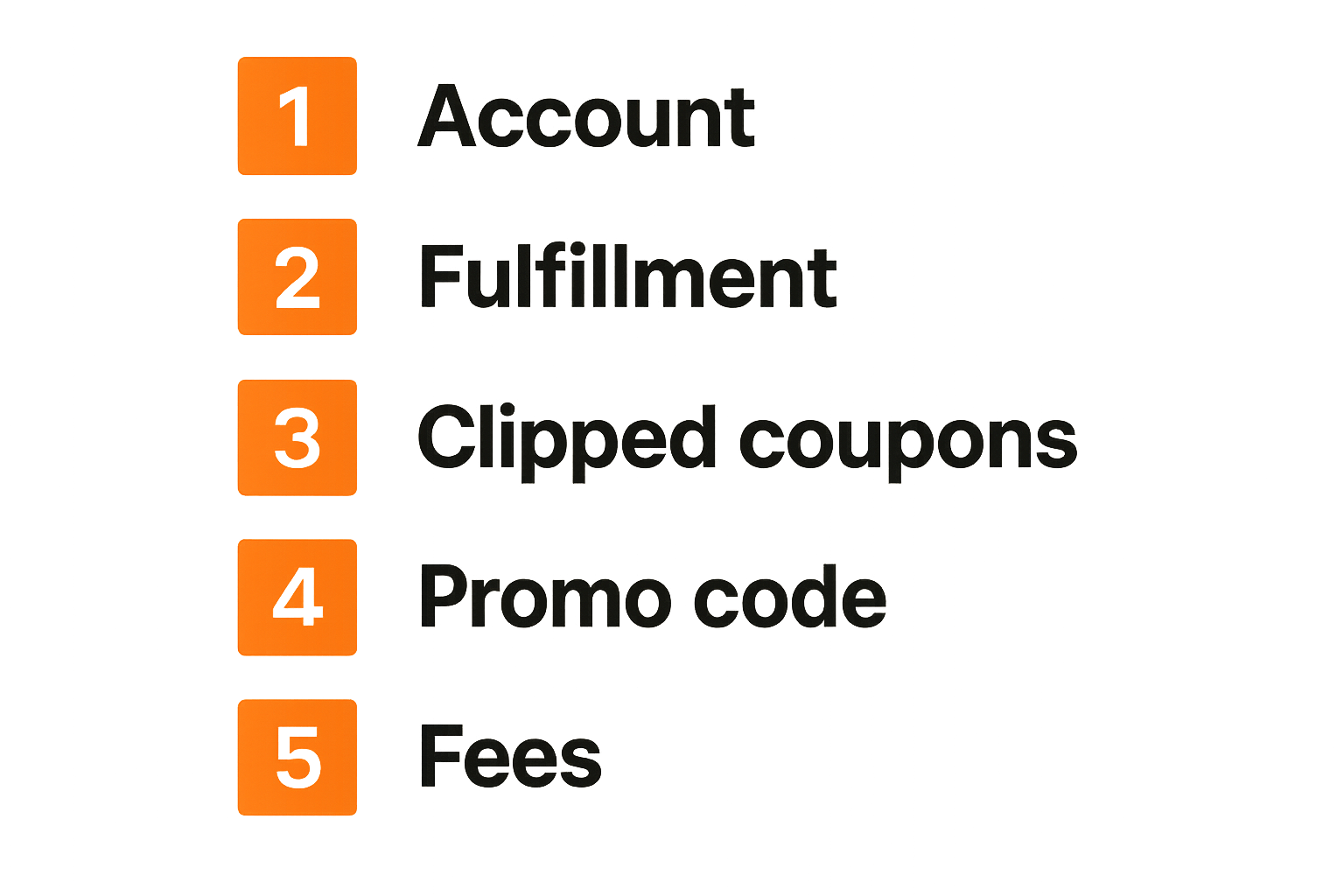
A basic account prep sequence looks like this:
- Sign in to your Walgreens account.
- Confirm your myWalgreens membership is active.
- Clip relevant digital coupons for items already in your cart.
- Check whether rewards or cash benefits are available.
- Reopen the cart and confirm the subtotal changed as expected.
This is boring, but it saves time. Testing promo codes against an unprepared cart produces bad information.
Decide shipping, pickup, or same-day delivery first
Fulfillment is not just logistics. It changes discounts.
Shipping may unlock free shipping thresholds or online-only codes. Pickup may qualify for pickup-specific promos and avoid shipping fees. Same-day delivery may add fees that erase a discount. If you switch after testing a code, you need to retest the total.
Practical rule: Choose fulfillment before testing codes. Shipping, pickup, and delivery are different discount environments.
For Walgreens, pickup can be especially useful for smaller orders. A ten percent code that saves two dollars is not helpful if shipping costs six dollars. A pickup order with sale prices and clipped coupons may beat a stronger-looking online code.
Separate manufacturer deals from promo codes
Manufacturer coupons are usually tied to specific products or brands. Promo codes are usually tied to order rules: category, cart value, fulfillment method, or customer eligibility. Treat them differently.
The mistake teams make is mixing all discounts into one bucket called coupons. That hides the real decision. A manufacturer coupon might reduce the price of one toothpaste. A Walgreens promo code might reduce a beauty order. Rewards might return value after purchase. These are separate layers with separate failure modes.
A simple savings stack looks like this:
- Sale price or weekly deal
- Manufacturer or digital coupon
- Walgreens coupon code or promo code
- Rewards or cash back value
- Shipping, pickup, or delivery fee impact
Your final savings number should include all five, not just the code discount.
Where to find a Walgreens coupon code without wasting the evening
Search community coupon databases first
Start where shoppers report what actually worked. A community coupon database is useful because it gives you recent attempts, not just polished promo language. You can search for a Walgreens coupon code on c0upons community search and compare current code patterns before opening five browser tabs.
The goal is not to believe the first result. The goal is to build a short candidate list. Three plausible codes are enough. Ten random codes usually create noise.
Look for signals like:
- Recent successful use
- Clear category notes
- Minimum spend details
- Fulfillment notes such as pickup only or online only
- Comments that explain why a code failed
Check Walgreens promo surfaces in a fixed order
After community search, check Walgreens-owned surfaces in a consistent order. This prevents duplicate testing and reduces the chance you miss an account-specific offer.
Use this order:
- Walgreens homepage banners and sale pages.
- Cart and checkout promo prompts.
- myWalgreens digital coupons.
- Email or SMS offers you personally received.
- App-only offer areas if you use the app.
- Coupon community reports for current public codes.
If you jump around, you lose track of which offer came from where. That matters when a discount disappears after you change the cart.
Read comments and timestamps like a verifier
A code from yesterday is better than a code from three months ago. A comment saying worked on beauty pickup over $35 is better than worked great. Good coupon data has conditions.
This is also where community behavior matters. Related reading from our network: the operating guide on local community trust and routing is not about coupons, but the same principle applies here: communities get more useful when people share context, not just outcomes.
Treat coupon comments like lightweight verification logs. You are looking for patterns, not guarantees.
How to test Walgreens promo codes correctly
Use a clean cart and one variable at a time
Testing five codes while also adding items, switching pickup stores, and clipping coupons is how shoppers fool themselves. Use one variable at a time.
A clean test means:
- The cart contains the items you actually plan to buy.
- You are signed in.
- Fulfillment is selected.
- Digital coupons are clipped or intentionally not clipped.
- You record the pre-code total.
Then test one code. If it fails, remove it completely before testing the next one. If the cart changes, reset your baseline.
Watch the discount line, not the banner
Retail checkout pages often show encouraging messages that do not equal actual savings. You may see a success banner, but the order total only drops by a smaller amount than expected. Or a code may apply to one eligible item and not the full order.
Watch the discount line and final total. The final total is the only number that matters.
Practical rule: A Walgreens promo code worked only if the final payable total improved after fees, shipping, taxes where applicable, and rewards tradeoffs.
This is where many shoppers overstate savings. Saving five dollars while adding a delivery fee is not always a win. Getting rewards later may be useful, but it is not the same as paying less today.
Keep a short code test log
You do not need a complicated spreadsheet. A short note is enough:
- Cart type: beauty, household, photo, mixed
- Fulfillment: pickup, shipping, delivery
- Baseline total
- Code tested
- Result
- Reason shown, if any
Example:
beauty pickup, $42 subtotal, CODEA tested, failed, message says category not eligible
This keeps you from testing the same dead code twice. It also helps the next shopper if you share the result.
Walgreens coupon code stacking: what works and what fails
What usually works
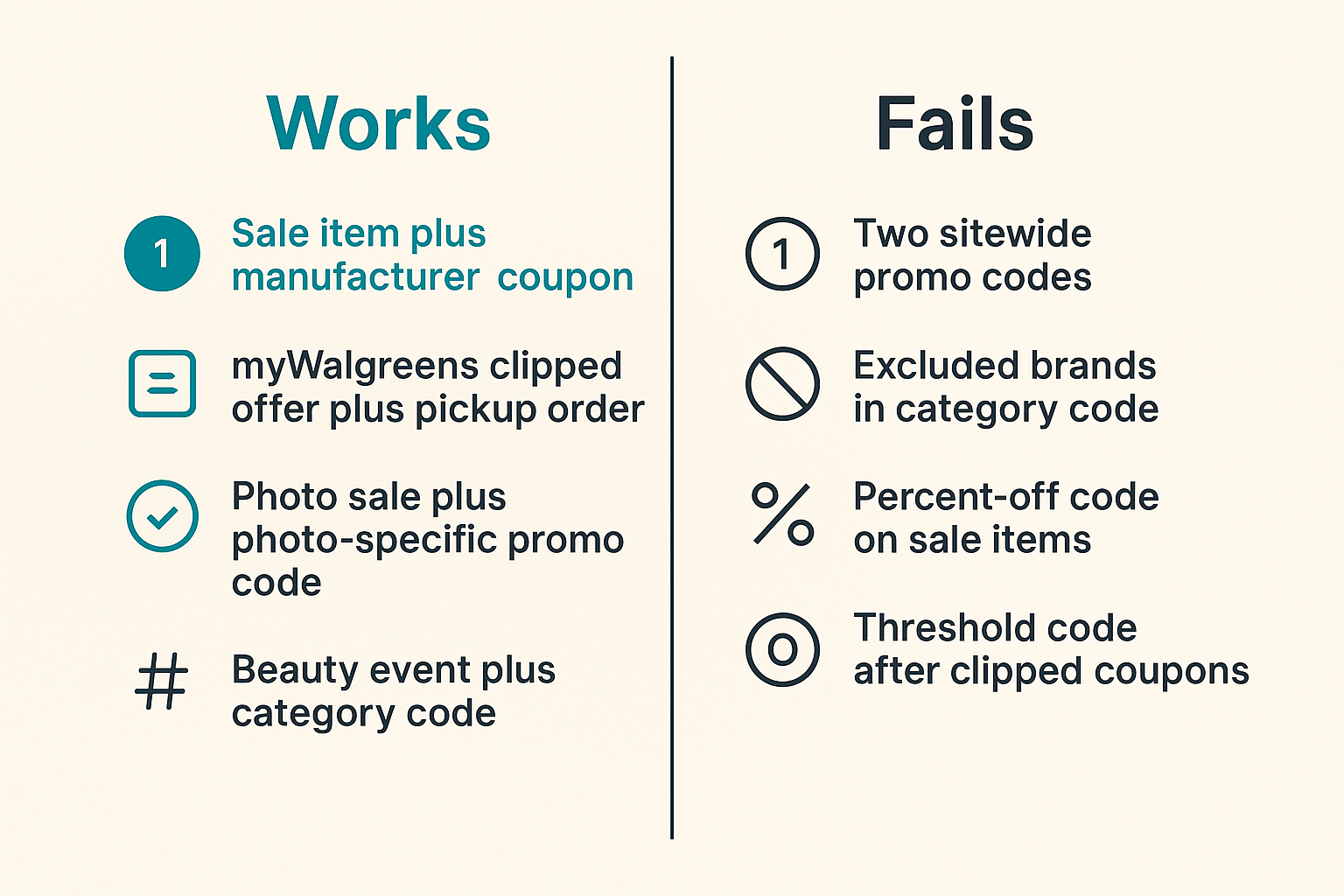
What works is stacking discounts that operate at different layers. A sale price plus a clipped product coupon plus a pickup promo can be a strong combination when each layer is eligible.
Commonly worth testing:
- Sale item plus manufacturer coupon
- myWalgreens clipped offer plus pickup order
- Photo sale plus photo-specific promo code
- Beauty event plus category code
- Free pickup instead of shipping on a small cart
The key is not stacking for its own sake. The key is comparing final totals. Sometimes the simpler stack wins because it avoids exclusions.
What usually fails
What fails is trying to force two discounts that operate in the same lane. Two sitewide promo codes usually will not stack. A category code may not apply to excluded brands. A percent-off code may ignore sale items. A threshold code may fail after clipped coupons reduce the subtotal.
The mistake teams make is assuming the cart sees discounts in the same order the shopper sees them. Checkout systems often calculate eligibility after certain discounts, not before. That changes the conversation because your $40 cart may become a $34 eligible subtotal after product coupons.
Related reading from our network: home media shoppers face similar architecture issues when small device choices change the whole setup; this guide to plug tech for cord cutters is adjacent, but the lesson is familiar: the visible interface is not the whole system.
Comparison table: stacks worth trying
| Savings approach | Best for | What to verify | Risk |
|---|---|---|---|
| Sale price plus clipped coupon | Household basics, oral care, vitamins | Coupon attaches to the exact item size and quantity | Wrong size or excluded variety |
| Category Walgreens coupon code | Beauty, personal care, seasonal categories | Category eligibility and minimum spend | Sale items may be excluded |
| Photo promo code | Prints, books, cards, canvas | Product type and pickup or shipping rule | Photo codes rarely help normal retail carts |
| Pickup instead of shipping | Small or medium local orders | Store availability and pickup timing | Item substitution or stock mismatch |
| Rewards-focused order | Repeat Walgreens shoppers | Whether value arrives after purchase | Not the same as instant savings |
Use the table as a filter. If your cart does not match the best-for column, do not spend long testing that route.
Common Walgreens coupon code failure modes
Exclusions hide in product categories
The most common failure is not a fake code. It is an exclusion. Health products, regulated items, premium beauty brands, clearance, sale items, and certain personal care categories may have special rules. The code can be real and still useless for your cart.
This is why mixed carts are hard. A cart with vitamins, cosmetics, photo prints, and cleaning supplies may only have one eligible line item. A percent-off code may technically work but save far less than expected.
When that happens, split the cart mentally. Ask which items actually drive the discount. If only one low-value item qualifies, the code is not worth optimizing around.
Pickup and delivery can change eligibility
Pickup and delivery are not neutral. Store inventory, location, fees, and fulfillment rules can change the total. A code that works for shipping may not work for pickup. A pickup promo may disappear if one item is unavailable at your chosen store.
What breaks in practice is substitution. If the item that qualified you for the threshold is out of stock, your final deal can weaken. For essential items, that may still be fine. For a carefully built coupon stack, it can ruin the math.
If a deal depends on a narrow threshold, avoid carts where one unavailable item breaks the whole order.
Minimum spend thresholds are easy to misread
Minimum spend thresholds are where many Walgreens coupon code attempts fail. The phrase spend $35 can mean different things depending on the offer. It may be before tax, after digital coupons, excluding certain brands, or limited to a category.
Do not pad a cart blindly. Adding eight dollars of items to save five dollars is not savings unless you truly need those items soon.
Practical rule: Padding is only rational when the added item is useful, fairly priced, and does not create a bigger shipping or pickup problem.
A good padding item is something you would buy anyway: toothpaste, soap, trash bags, vitamins you use, or household basics. A bad padding item is anything that expires, clutters your home, or exists only to satisfy a banner.
A 10-minute Walgreens coupon code workflow for 2026
Step 1 to 3: prepare the cart
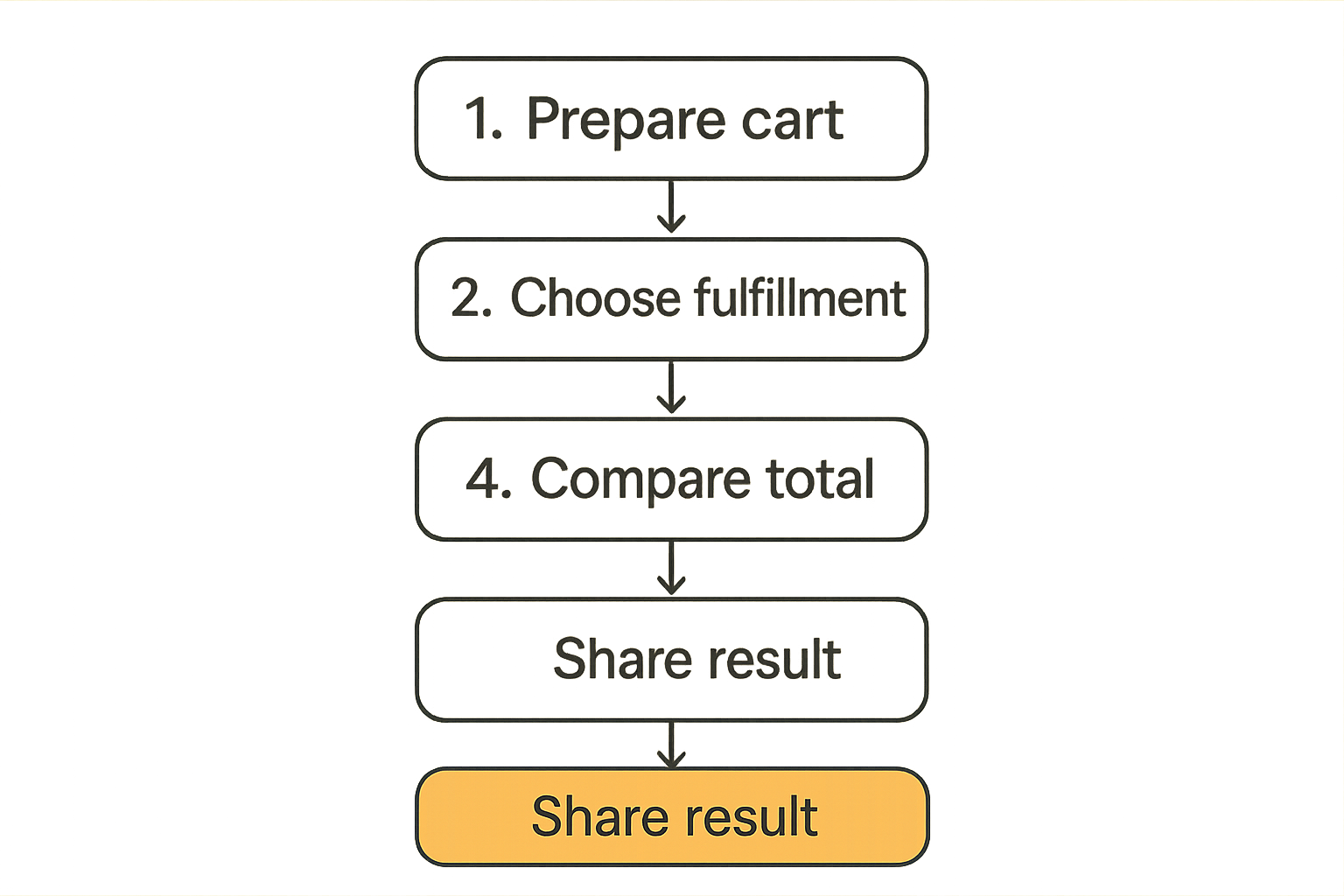
Here is the workflow I would use if I had ten minutes and wanted a realistic result.
- Build the real cart. Add only items you are willing to buy today.
- Sign in and confirm myWalgreens status. Clip obvious product coupons.
- Choose fulfillment. Decide pickup, shipping, or delivery before testing codes.
This sequence removes the biggest source of false failures. If the code fails after this, you have a cleaner signal.
Do not start by searching for twenty codes. Build the checkout environment first.
Step 4 to 6: test and compare totals
- Record the baseline final total. Include fees and shipping.
- Test up to three Walgreens coupon code candidates. Use recent, relevant codes first.
- Compare the final payable total, not the advertised discount.
If none of the codes work, do not spiral. Check whether a sale-only or coupon-only cart already gives a better price than forcing a promo code.
The best deal is sometimes no promo code. That sounds strange in a coupon guide, but it is true in production checkout. Sale pricing plus clipped coupons can beat a weak code with exclusions.
Step 7 to 8: decide, save, and share
- Decide whether the savings justify the order now. If not, wait for a better sale cycle.
- Share the code result with conditions so other shoppers do not repeat your test.
A simple share is enough: worked on photo pickup over $25 today, failed on household cart, or applied only to eligible beauty items. That kind of note is more useful than a bare code.
This is how coupon communities improve. Not through hype, but through better test results.
Edge cases: prescriptions, photo, beauty, and household staples
Prescription discounts need separate handling
Do not treat prescriptions like normal retail items. Pharmacy pricing can involve insurance, savings cards, regulatory limits, and separate discount programs. A normal Walgreens coupon code may not apply.
The practical approach is to separate pharmacy decisions from retail couponing. Check pharmacy-specific savings options, insurance pricing, and any eligible health programs independently. Then handle the rest of the cart with the normal workflow.
This avoids a common mistake: assuming a retail code should reduce a prescription order. Often it will not, and the failure tells you little about whether the code works elsewhere.
Photo codes are their own lane
Walgreens photo deals are often strong, but they behave like a separate store inside the store. Prints, cards, books, posters, and canvas products may have their own promo calendar and code patterns.
If you are ordering photo products, search for a photo-specific Walgreens promo code first. A general retail code may not be the best option. Also compare pickup versus shipping, because photo pickup can be a major part of the savings.
Photo orders reward patience. If the order is not urgent, waiting for a better photo promo can beat spending time forcing a weak current code.
Beauty and household categories reward timing
Beauty and household staples are where normal shoppers can save consistently. The trick is timing purchases around sale cycles and stacking eligible coupons.
For beauty, watch category events, brand exclusions, and reward offers. For household basics, focus on items you always use and avoid overbuying. The savings goal is not a dramatic one-time screenshot. It is lowering repeat purchases over time.
A useful way to think about it is inventory planning. If you know you will need detergent, toothpaste, shampoo, and vitamins this month, you can buy when Walgreens pricing is favorable instead of waiting until you run out.
How deal hunters should contribute better Walgreens codes
Share the conditions, not just the code
A coupon code without conditions is half a data point. When you share a Walgreens coupon code, include the context that made it work or fail.
Useful details include:
- Date tested
- Cart category
- Approximate subtotal
- Fulfillment method
- Account or loyalty requirement if visible
- Error message if it failed
If you find a working deal, you can help the next shopper by posting the code and conditions through the c0upons submit page. Community couponing works best when shoppers share the operating details, not just the headline.
Mark dead codes quickly
Dead codes waste time. A code can die because the promotion expired, the usage cap was reached, or Walgreens changed eligibility rules. Marking a dead code is not negative; it is maintenance.
What breaks in practice is old code gravity. A once-popular code keeps getting copied, reposted, and retried long after it stopped working. Shoppers waste checkout time because the internet remembers the code but forgets the conditions.
If you test a code and it fails clearly, report the failure with context. If it failed only for your cart, say that. There is a difference between dead and not eligible.
Build trust with repeatable evidence
The best coupon contributors behave like good operators. They test, describe the environment, and avoid overclaiming.
Good evidence sounds like this:
- Worked today on $38 beauty pickup order after clipped coupons.
- Failed on vitamins, message said item excluded.
- Applied to photo cards but not retail cart.
- Saved $7.50 after switching from shipping to pickup.
Bad evidence sounds like this:
- Best code ever.
- Works for everything.
- Hurry now, guaranteed.
- I heard this stacks with all offers.
Coupon communities do not need louder claims. They need cleaner signals.
Where c0upons.com fits in the Walgreens coupon code workflow
Use community search as the first filter
c0upons.com is useful in this workflow as a first filter, not a replacement for checkout testing. You want to reduce the candidate list before you reach Walgreens checkout. That means finding recent codes, reading conditions, and ignoring obvious noise.
This fits the way real shoppers behave. Most people are not trying to become coupon experts. They want to know which codes are worth testing now, what categories they apply to, and whether another shopper saw the same result.
A community coupon site is strongest when it shortens the search phase and gives shoppers better tests to run.
Treat shared codes as inputs, not guarantees
No coupon database can guarantee that every Walgreens coupon code will work for every cart. Eligibility can depend on account state, item mix, fulfillment, date, location, inventory, and promotion rules.
So treat shared codes as inputs. The workflow still matters:
- Prepare the cart.
- Confirm account and clipped offers.
- Choose fulfillment.
- Test recent relevant codes.
- Compare final totals.
- Share the result.
That is the difference between deal hunting and code gambling.
Closing checklist before you pay
Before you place the order, run this final checklist:
- Am I signed in, and are myWalgreens offers visible?
- Did I clip product coupons before testing promo codes?
- Did I choose pickup, shipping, or delivery before comparing totals?
- Did I check whether the code discount actually changed the final payable total?
- Did shipping or delivery fees erase the savings?
- Am I padding the cart with items I truly need?
- Is this Walgreens coupon code better than waiting for a category sale?
If the answer is clean, place the order. If the deal depends on confusing math, walk away or simplify the cart.
The closing point is practical: a Walgreens coupon code is valuable when it fits the cart architecture. The best shoppers do not paste forever. They test with structure, keep the winning total, and share what actually worked.
Try c0upons.com
c0upons.com helps online shoppers find practical ways to save money with coupon codes, promo codes, sales, and deal roundups. Start your next Walgreens coupon code search here: Try c0upons.com.