Papa Johns Promo Codes in 2026: A Practical Checkout Workflow for Real Savings
You find a pizza promo code, paste it into checkout, and the discount either fails, applies to the wrong item, or saves less than the deal already sitting on the menu page. That is the normal Papa Johns promo codes experience in 2026.
Teams think the problem is finding more codes. The real problem is running a better checkout workflow.
That sounds too structured for a pizza order, but the logic is simple: coupon savings are not decided on a coupon page. They are decided by cart contents, location, order type, minimum spend, taxes, delivery fees, rewards rules, and whether the offer can stack with anything else.
The practical question is not “What is the best code?” It is “Which discount produces the lowest final total for this specific order?” That changes the conversation.
Table of contents
- Why Papa Johns promo codes fail at checkout
- Build a savings workflow before you order
- Where to find Papa Johns promo codes in 2026
- How to validate a code before you trust it
- Compare Papa Johns promo codes against menu deals
- What breaks in practice
- A practical checkout sequence for pizza orders
- What works for groups families and repeat orders
- Keep a personal coupon log
- How c0upons.com fits into the workflow
- Papa Johns promo codes closing checklist
Why Papa Johns promo codes fail at checkout
The mistake teams make is treating a promo code like a standalone object. It is not. A promo code is a conditional rule that only matters after it meets the checkout system.
For Papa Johns, that system includes your store location, menu configuration, whether you choose delivery or carryout, your cart total before and after discounts, whether specialty pizzas qualify, and whether the deal conflicts with another offer already applied.
The code is not the deal
A code printed as “25% off” looks better than a $6.99 carryout special until you build the cart. A “free item” code looks strong until it requires a minimum spend you were not planning to hit. A “large pizza deal” can fail if your crust, toppings, or specialty selection sits outside the offer rules.
A useful way to think about it is this:
Practical rule: A Papa Johns promo code is only valuable after it beats the best no-code deal available in the same cart.
That means you should not judge a code by the headline. Judge it by final payable total.
The final total is the only number that matters because a pizza order has several moving parts:
- Menu price before discounts
- Promo or coupon discount
- Delivery fee or carryout difference
- Service fees where applicable
- Taxes
- Tip
- Rewards redemption
- Minimum order thresholds
- Item exclusions
If a code saves $4 but pushes you into an unnecessary extra item, it may not be a saving. It may be a nudge to spend more.
Local pricing changes the math
Papa Johns pricing can vary by store, region, delivery zone, and current promotion. One shopper may get a strong large pizza deal in one city while another sees a different menu price entirely. That is why copying a code from a random thread without testing it is unreliable.
The practical question is not whether the code worked for someone. It is whether it works for your store, your order type, and your cart.
This is also why old screenshots can be misleading. A coupon that worked last Friday for carryout may fail today for delivery. A limited-time sports deal may work in one market but not another. A national campaign may have local exclusions.
What breaks in practice is assuming coupon success is portable. It often is not.
Build a savings workflow before you order
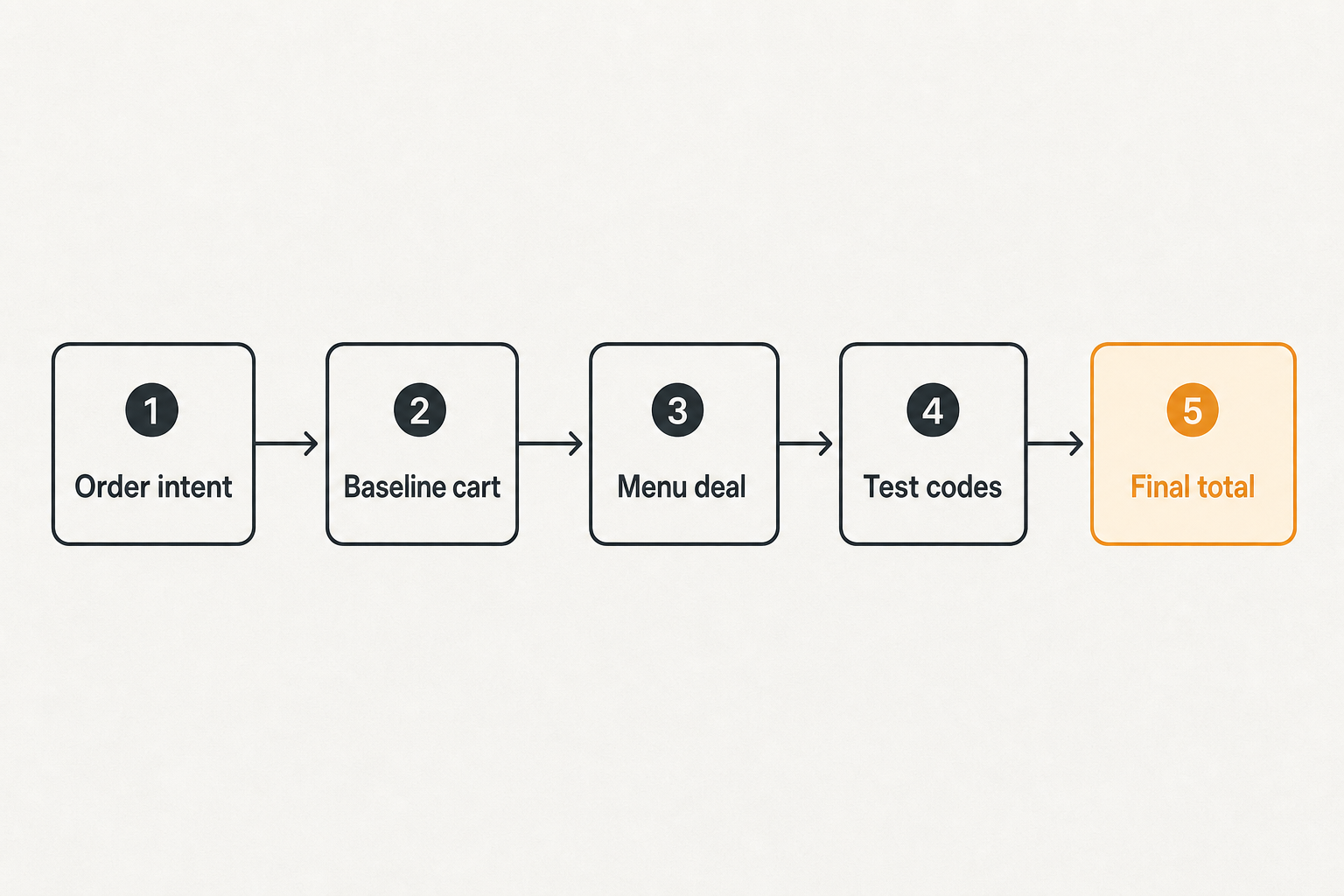
The fastest way to save is not to test twenty random codes. It is to build a small decision loop before you start adding extras.
Most shoppers do this backwards. They build a dream cart, get attached to it, then hunt for a discount that justifies the total. Better approach: decide what you actually need, price it a few ways, then let the winning cart determine the order.
Start with order intent
Before searching for Papa Johns promo codes, define the order in plain terms:
- One person lunch
- Two-person dinner
- Family meal
- Game night group order
- Carryout on a budget
- Delivery when convenience matters more than lowest price
This matters because the best code for a single pizza is often not the best deal for a group order. A percent-off code usually improves as cart size grows. A fixed-price bundle may beat everything for families. A carryout-only deal may crush delivery pricing if pickup is realistic.
Practical rule: Match the discount type to the order type before you compare codes.
A single-person order should avoid minimum spend traps. A family order should test bundles first. A group order should compare percent-off codes against multi-pizza deals. A delivery order should include fees and tip in the final calculation, not as an afterthought.
Related reading from our network: shoppers are not the only ones dealing with workflow problems behind simple buttons; software teams face similar handoff and state issues in screen sharing software development, where the visible interface is only part of the system.
Create a quick comparison loop
Use a simple loop:
- Build the lowest reasonable cart with no code.
- Check Papa Johns built-in deals.
- Test one or two relevant promo codes.
- Compare final totals.
- Remove anything added only to satisfy a minimum.
- Choose the lowest final total that still matches the meal you wanted.
The “remove anything added only to satisfy a minimum” step is where many shoppers find the truth. If you added breadsticks only because a code needed a higher subtotal, count the cost of the breadsticks. Do not pretend the code saved money if it changed the order.
This is the same discipline coupon communities use when a deal looks good on the surface but gets weaker at checkout. The total has to survive the full cart.
Where to find Papa Johns promo codes in 2026
There are three practical sources: official Papa Johns channels, coupon communities, and your own history. The mistake teams make is relying on only one.
Official sources tend to be cleaner but limited. Community sources are broader but noisier. Your own history is highly relevant but easy to forget.
Official channels and app offers
Start with the Papa Johns website or app because built-in offers often apply cleanly. These may include menu deals, carryout specials, rewards offers, limited-time bundles, or local store promotions.
Official offers are not automatically best, but they are important baselines. If a third-party promo code saves less than the built-in deal, the built-in deal wins.
Look for:
- Deals shown on the Papa Johns homepage or app
- Carryout specials
- Large pizza specials
- Combo or family bundles
- Rewards redemption options
- Email or SMS offers if you opted in
- Local store banners during checkout
The practical move is to capture the no-code baseline and the official deal baseline before testing outside codes. Without that baseline, you cannot tell whether a code is actually better.
Community coupon sources
Community coupon pages are useful because shoppers report what worked recently, where it worked, and what failed. They are especially helpful when official offers are weak or when you are placing a larger order where a percent-off code could beat a bundle.
Use community sources with skepticism. A working code should still be tested in your cart. A failed code may still work in a different region or order type. A “best” code may be best only for one cart shape.
If you want a broader coupon check without jumping across dozens of tabs, use a community coupon search like search thousands of community-submitted coupon codes and then test only the codes that match your order type.
For a deeper adjacent walkthrough focused on the same brand, our earlier guide on Papa Johns promo codes in 2026 covers a similar verification workflow from the deal-hunting side.
How to validate a code before you trust it
Finding a code is cheap. Validating it is the work.
Many shoppers waste time because they paste codes late in checkout without reading the restrictions. Then they keep retrying variants of the same failed offer. That is not deal hunting. That is guessing.
Check restrictions first
Before applying a Papa Johns coupon code, scan for the conditions that commonly decide success:
- Carryout only or delivery allowed
- Minimum spend before taxes and fees
- Specific pizza size
- Specialty vs one-topping restrictions
- New customer only
- App-only or online-only
- Local store participation
- Expiration date
- Rewards conflict
- One coupon per order
Practical rule: If the restriction changes what you planned to order, compare the changed cart against your original cart before calling it a discount.
A code that requires two large pizzas is useless for one person unless you wanted leftovers. A free side with a minimum spend may be fine for a family order and wasteful for a solo order. A carryout-only deal is not relevant if delivery is non-negotiable.
This is where discipline matters. Do not let the coupon design the meal unless the new meal is still useful.
Test the cart state
Promo codes apply against a cart state. Change the cart and you may change the result.
Test with the cleanest possible cart first:
- Add the required item only.
- Apply the code.
- Confirm whether the discount appears.
- Add optional items after the code works.
- Recheck the final total.
This isolates the reason for failure. If the code fails on a clean qualifying cart, the issue is likely expiration, region, account eligibility, or store participation. If it works on a clean cart but fails after extras, one of the added items may conflict with the offer.
Related reading from our network: this is similar to optimization problems in content operations, where the winning move is not “do everything” but prioritize the highest-impact constraints first, as shown in this guide to scipy optimization minimize for AEO.
Compare Papa Johns promo codes against menu deals
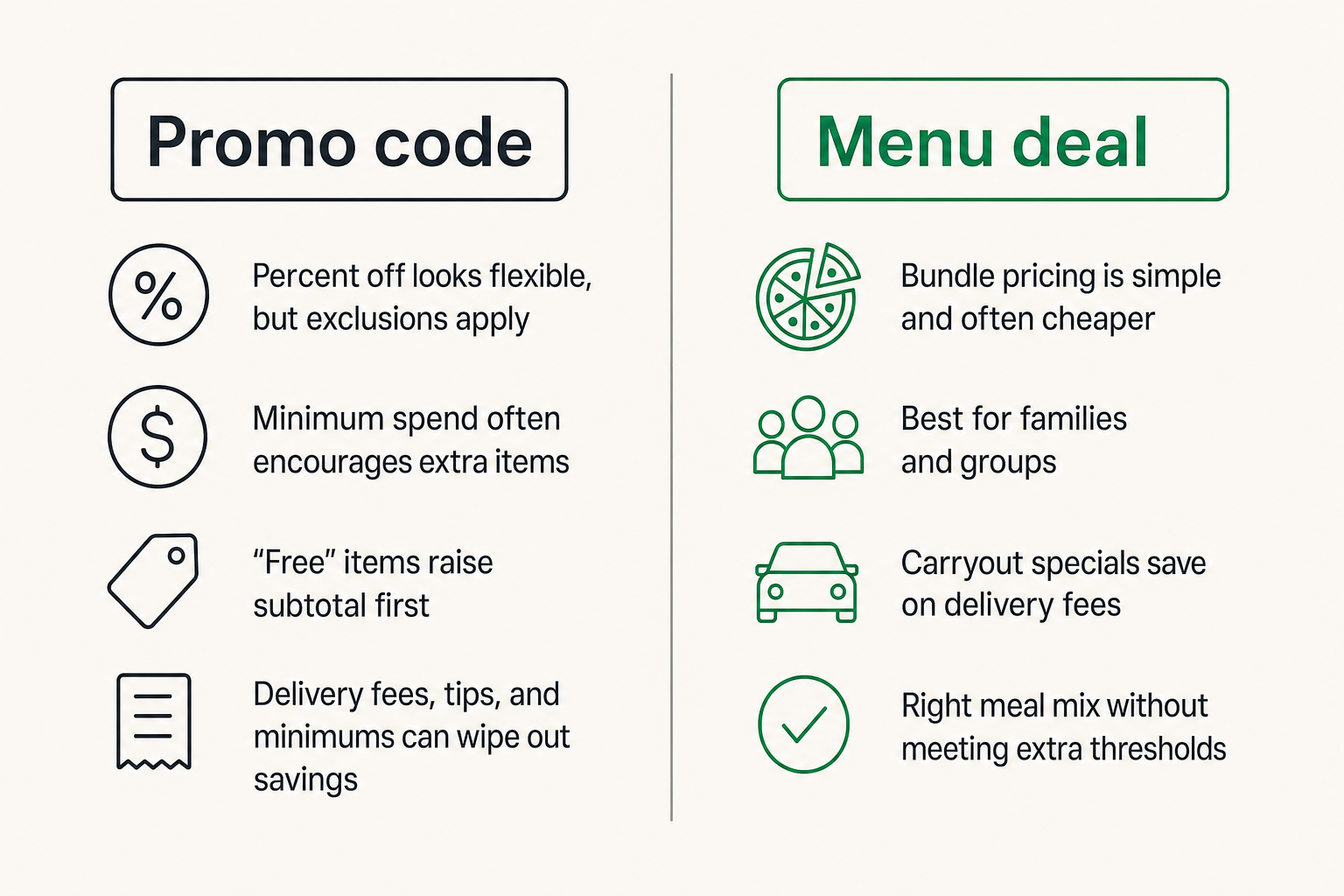
A coupon code is one discount path. Menu deals are another. Rewards are another. The checkout winner is whichever path produces the best final order.
The practical question is: what are you comparing the code against?
Percent off vs bundle pricing
Percent-off codes look flexible. Bundle pricing looks boring. In production, boring often wins.
| Discount type | Best for | What to watch | Failure mode |
|---|---|---|---|
| Percent off | Larger carts, group orders | Exclusions and maximum discount | Looks strong but excludes specials |
| Fixed dollar off | Medium carts near a threshold | Minimum spend | Encourages extra items you did not need |
| Free item | Orders that already hit minimum | Item eligibility | “Free” side raises subtotal first |
| Carryout special | Budget orders and planned pickup | Pickup feasibility | Not useful if delivery is required |
| Bundle deal | Families and groups | Customization limits | Cheaper headline but wrong meal mix |
| Rewards redemption | Repeat customers | Stacking rules | Double-counting savings already earned |
The mistake teams make is comparing the discount labels instead of the final totals. A 30% code sounds better than a $7.99 pizza. It may not be. If the $7.99 pizza is the meal you wanted and the percent-off code requires a larger cart, the bundle or menu deal wins.
Delivery fees, tips, and minimums
Delivery changes the math. A promo code that saves $5 on food may not offset delivery fees and tip compared with carryout. That does not mean delivery is wrong. It means you should be honest about the tradeoff.
Separate the decision into two questions:
- Do I need delivery for this order?
- If yes, what is the best delivery cart?
Do not compare carryout and delivery as if convenience has no value. If you can pick up, carryout deals may produce the lowest total. If you cannot, optimize inside the delivery path instead of feeling like every delivery order is a failure.
Minimums are the other trap. If a promo code requires $25 before tax and your planned order is $18, the real cost is not just the discounted total. The real cost includes the extra $7 or more you had to add.
What breaks in practice
Coupon workflows fail for predictable reasons. The code is expired. The page is stale. The store is excluded. The cart does not qualify. The shopper stacks discounts that cannot stack. Or the shopper mistakes advertised savings for real savings.
None of this is dramatic. It is normal checkout behavior.
Expired codes and stale pages
Coupon pages age quickly. Food promos can move even faster because campaigns are tied to seasons, sports events, holidays, local demand, or app pushes. A code that worked yesterday can fail today.
Signs a code may be stale:
- No recent success reports
- Vague wording with no restriction details
- Old seasonal language
- No mention of carryout vs delivery
- Big discount with no minimum listed
- Multiple users reporting failure
What works is prioritizing recent, specific feedback. “Worked for carryout large one-topping on August 29” is more useful than “best pizza code.” Specificity beats hype.
Store exclusions and location rules
Papa Johns is a national brand with local store participation. That means a code may be real but still fail for your store.
Common location issues include:
- Local franchise not participating
- Regional campaign only
- Delivery zone restrictions
- Store-specific menu pricing
- Online-only offer not supported by selected store
- App offer not mirrored on desktop checkout
When this happens, do not keep brute-forcing the same code. Change the diagnostic:
- Try carryout if delivery failed and pickup is realistic.
- Try the same cart with a nearby store if available.
- Try an official menu deal instead.
- Try a smaller set of community codes with recent success notes.
The goal is not to prove a code should work. The goal is to get the lowest real total before your patience expires.
Related reading from our network: merchants face similar state and settlement tradeoffs when payments look simple on the surface but depend on infrastructure underneath, as explained in this piece on cloud computing crypto settlement architecture.
A practical checkout sequence for pizza orders
This is the operator version of ordering pizza: reduce variables, test the highest-probability paths, and stop when the savings no longer justify the effort.
You do not need a spreadsheet for every order. You need a repeatable sequence.
Step by step workflow
Use this sequence when the order matters enough to optimize:
- Choose delivery or carryout first. Do not compare deals across order types unless both are realistic.
- Build the plain cart. Add only the food you actually want.
- Record the no-code total. This is your baseline.
- Check Papa Johns menu deals. Rebuild the cart using the best visible deal.
- Record the menu-deal total. Include fees and taxes shown at checkout.
- Test one high-fit promo code. Choose based on order type, not headline size.
- Test one backup code. Stop after a small number of relevant attempts.
- Compare final totals. Use payable total, not advertised discount.
- Remove coupon-driven extras. If the code forced extra spend, rerun the comparison.
- Place the order. Do not lose twenty minutes chasing a marginal improvement.
This workflow matters because it prevents random testing. Random testing creates noise. A clean sequence creates decisions.
When to stop testing
There is a point where another code is not worth it. For a small order, saving an extra dollar after ten failed attempts is a bad trade. For a large group order, testing a few more codes may make sense.
A practical stopping rule:
Practical rule: Stop testing when the next likely discount is smaller than the value of your time or when your food choices start changing only to satisfy coupon rules.
For most pizza orders, two or three well-matched codes are enough. If none beat the menu deal, take the menu deal. If a code works but changes the order into something you did not want, reject it.
The best coupon users are not the people who test the most codes. They are the people who stop at the right time.
What works for groups families and repeat orders
Pizza savings improve when the order pattern is predictable. Families and groups often repeat the same cart: two large pizzas, one side, drinks, or a set number of toppings. That makes comparison easier.
The more repeatable the order, the more useful your previous checkout results become.
Save the order pattern
If you order Papa Johns regularly, save the cart pattern mentally or in a note:
- Typical number of pizzas
- Usual sizes and crusts
- Toppings that matter
- Delivery vs carryout preference
- Average baseline total
- Best past menu deal
- Best past promo code type
You are not trying to build a financial model. You are giving yourself a reference point. If your usual family order is normally $34 after a good deal, a checkout total of $46 should trigger another pass.
What works is comparing today’s order against your own history, not against someone else’s screenshot.
Use rewards without double counting
Rewards are valuable, but they can distort your sense of savings. If you earned a reward from previous purchases, redeeming it today lowers today’s total. It does not mean today’s promo code did all the work.
Keep the categories separate:
- Promo code savings
- Menu deal savings
- Rewards redemption
- Gift card balance
- Delivery vs carryout savings
This matters when deciding whether a code is worth remembering. If the order was cheap because of rewards, the code may not be special. If the code beat menu deals without rewards, that is more useful for next time.
The same principle applies to group orders. If friends reimburse you, track the total before splitting. A code that saves $12 on a group order is real even if each person only feels a small difference.
Keep a personal coupon log
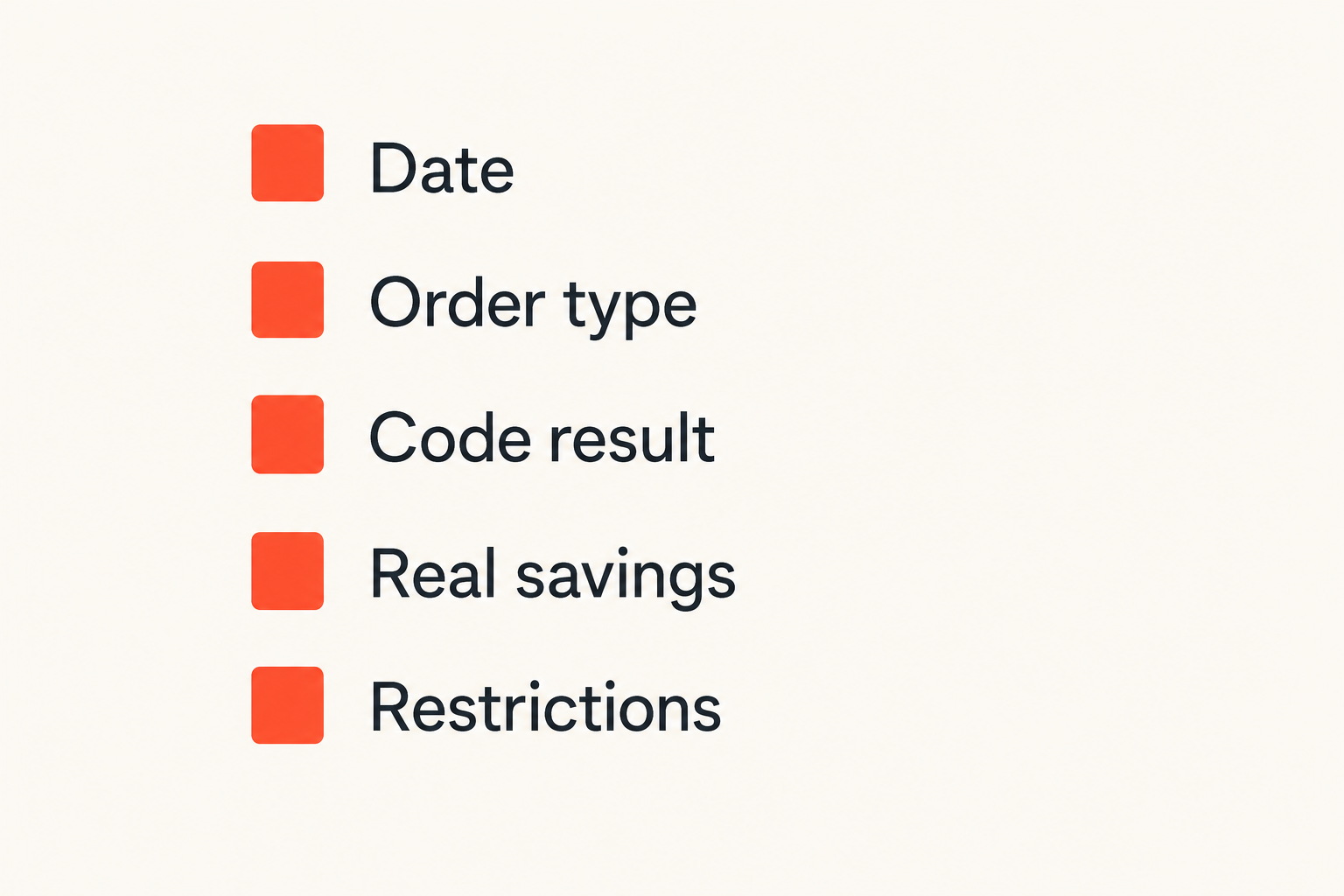
A personal coupon log sounds excessive until you realize it can be three lines in your notes app. The goal is not perfect tracking. The goal is avoiding the same failed codes and remembering the patterns that work.
What breaks in practice is memory. Shoppers remember the big advertised discount but forget the minimum spend, the carryout-only rule, or the fact that the code failed at their store.
Track real savings not advertised savings
Track these fields:
- Date
- Store or city area
- Delivery or carryout
- Cart type
- Code tested
- Worked or failed
- Final savings vs no-code baseline
- Notes on restrictions
Example:
| Date | Order type | Code result | Real note |
|---|---|---|---|
| Aug 31 | Carryout, 2 large | Worked | Beat menu deal by $3.40 |
| Aug 18 | Delivery, family bundle | Failed | Store exclusion message |
| Jul 29 | Solo order | Not worth it | Required extra side to hit minimum |
This log protects you from stale coupon loops. If a code failed twice for your store with the same message, it probably should not be your first test next time.
Share useful results with the community
Coupon communities get better when people share specific outcomes. “Didn’t work” is less useful than “failed for delivery in Chicago area on a specialty pizza cart.” “Worked” is less useful than “worked for carryout, two large one-topping pizzas, before tax.”
If you find a clean, current result, share the restriction details. If you confirm a stale code, report that too. Useful coupon data is operational: date, cart type, order type, and failure reason.
That is how deal pages become less noisy over time. Not because every code is perfect, but because enough shoppers report what happened in real carts.
How c0upons.com fits into the workflow
Coupon sites are most useful when they act as checkpoints, not magic buttons. The product-fit question is straightforward: where in the checkout workflow should a coupon community help?
For Papa Johns promo codes, the best role is discovery plus validation context. You still need to test the code in your cart. But you should not have to start from a blank search engine query every time.
Use search as a checkpoint
A practical workflow looks like this:
- Build your Papa Johns cart.
- Check the official menu deal.
- Use a coupon search checkpoint.
- Test one or two relevant codes.
- Compare final total.
- Share the outcome if it helps other shoppers.
This is where c0upons.com fits. It gives shoppers a place to search, compare, and contribute coupon information without pretending that every code will work for every cart.
The best use is targeted: search for the brand, look for recent and relevant codes, then return to checkout with a short list. Do not open fifteen tabs. Do not test codes that obviously mismatch your order type.
Make community feedback operational
The useful coupon detail is not only the code. It is the context around the code.
Good community notes answer:
- When was it tested?
- Was it delivery or carryout?
- What cart did it apply to?
- Did it stack with menu deals?
- What failure message appeared?
- Was there a minimum spend?
If you discover a working Papa Johns promo code or confirm that one no longer works, you can share the coupon result with the community so the next shopper has better signal.
That changes the conversation from “coupon sites are noisy” to “coupon data needs better feedback loops.” The tool is only useful if shoppers treat checkout results as data.
Papa Johns promo codes closing checklist
Papa Johns promo codes can still save money in 2026, but the winning move is disciplined comparison. Find codes, yes. But more importantly, test them against your actual cart, your store, and the menu deals already available.
The real problem is not scarcity of codes. The real problem is noisy validation.
Fast pre-check before you pay
Run this checklist before placing the order:
- Did you choose delivery or carryout intentionally?
- Did you record the no-code baseline?
- Did you check official Papa Johns deals?
- Did the promo code match your cart type?
- Did you include fees, taxes, and tip where relevant?
- Did the code force extra items?
- Did rewards make the discount look better than it is?
- Is the final payable total actually lower?
If the answer is yes, you have a real saving. If not, you have a headline discount.
Final decision rule
The final decision rule is simple:
Practical rule: Use the Papa Johns promo code only when it lowers the final total for the food you already wanted, without creating unnecessary spend or checkout friction.
That rule filters most bad deals quickly. It also keeps the process sane. You are ordering pizza, not auditing a procurement system.
Still, a small workflow helps. Start with intent, establish a baseline, test relevant codes, compare final totals, and remember what worked. That is how Papa Johns promo codes become practical savings instead of checkout roulette.
Try c0upons.com
c0upons.com helps online shoppers find practical ways to save money with coupon codes, promo codes, sales, and deal roundups. Start your next checkout with Try c0upons.com.