Papa Johns Coupons in 2026: A Practical Checkout Workflow for Real Pizza Savings
Papa Johns coupons look simple until checkout turns into a mess. A code works for one cart, fails for another, excludes your store, or saves less than the automatic deal already sitting in the app.
Teams think the problem is finding more Papa Johns coupons. The real problem is running a better checkout workflow.
That changes the conversation. You are not trying to collect every pizza promo code on the internet. You are trying to build an order path that compares real totals, catches restrictions early, and avoids wasting 20 minutes to save 80 cents.
The practical question is not whether a Papa Johns coupon exists in 2026. It is whether the coupon applies to your location, your order type, your basket, your loyalty account, your delivery choice, and the final price after fees.
Table of contents
- Why Papa Johns coupons are a workflow problem
- Build a coupon source stack before you order
- Compare Papa Johns coupon types before checkout
- The practical Papa Johns coupons workflow
- What works when stacking pizza deals
- What fails with Papa Johns coupons
- Track savings like an operator
- Sharing Papa Johns coupons with a community
- Mobile app web checkout and delivery app tradeoffs
- Closing make Papa Johns coupons part of the order system
Why Papa Johns coupons are a workflow problem
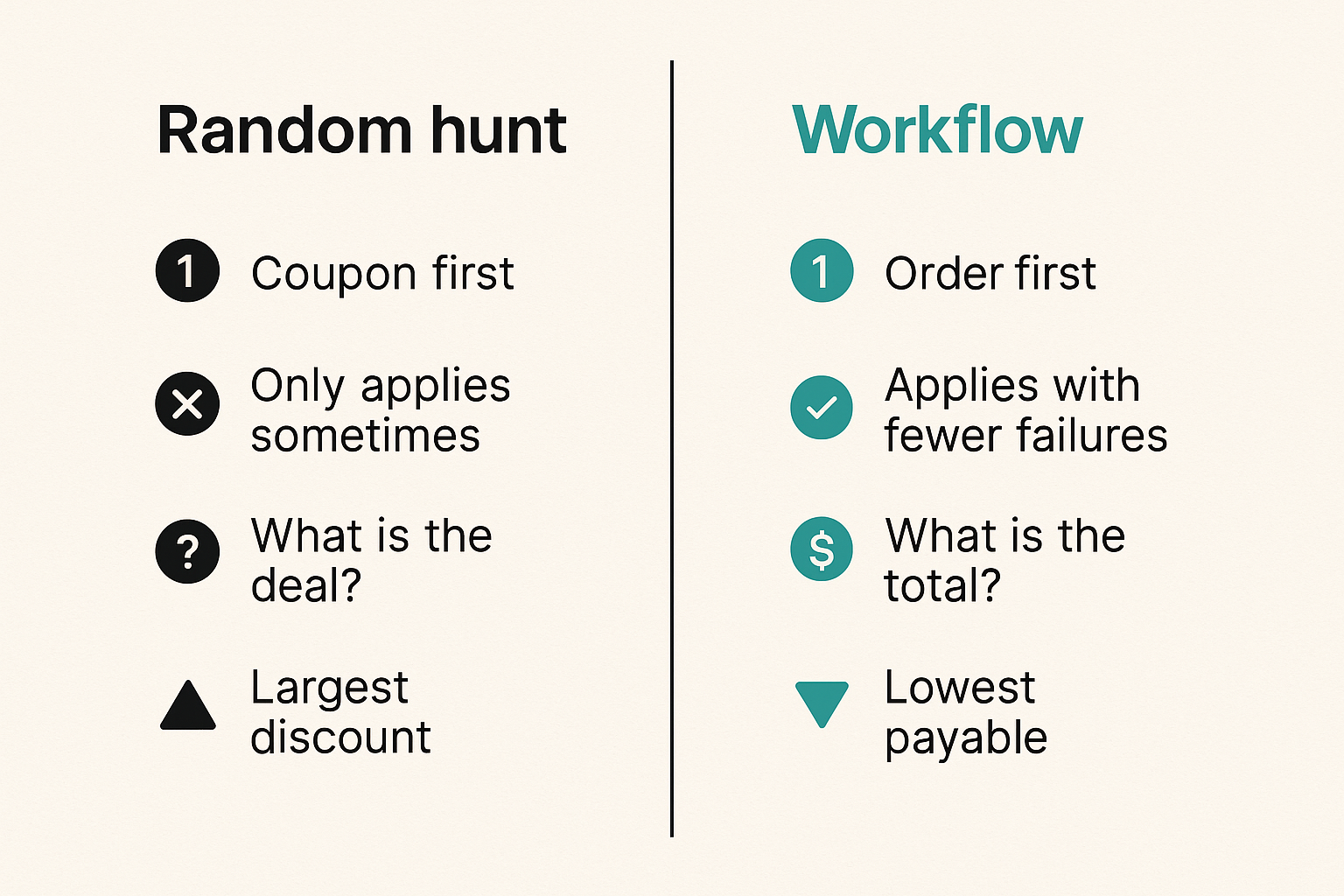
The discount is only one state in the order
A pizza order is not a single price. It is a chain of states: menu selection, store selection, carryout or delivery, coupon application, tax, fees, tip, loyalty points, payment method, and confirmation.
The mistake teams make is treating the coupon code field as the whole system. In practice, the code field is just one control in a bigger checkout architecture. If your cart is wrong, your location is wrong, or your order type is wrong, a good coupon can still fail.
A useful way to think about it is this: the coupon is not the deal. The final payable total is the deal.
That sounds obvious, but it changes how you order. You stop asking, what is the biggest percentage off. You start asking, what path produces the lowest confirmed total for the food you actually want.
Practical rule: Never judge Papa Johns coupons by the code description alone. Judge them by the final total after fees, tax, delivery, and tip.
Why 2026 deal hunting needs verification
In 2026, coupon discovery is crowded. Search results, social posts, browser extensions, app banners, expired screenshots, and group chats all compete for attention. Many codes are copied without context. Some were local. Some were one-time account offers. Some worked during a short campaign and then stayed online for months.
What breaks in practice is not that shoppers cannot find codes. It is that shoppers cannot tell which codes are worth testing.
Verification matters because Papa Johns pricing can vary by location and order type. A carryout offer may not apply to delivery. A national deal may be visible in the app but not stack with a local store special. A coupon that looks strong may require a minimum basket that pushes you into buying food you did not plan to order.
The practical workflow is to filter quickly, test only the likely winners, and stop once the total is good enough. Coupon hunting should reduce the cost of dinner, not become the dinner project.
Build a coupon source stack before you order
Start with official and high-signal sources
Before you search randomly, check the sources most likely to reflect live checkout behavior. That usually means the official Papa Johns app or website, email offers, rewards account messages, and reputable coupon communities.
For broader store discovery, it helps to browse organized deal pages rather than scattered posts. The community store directory is useful when you want a cleaner starting point for current codes across retailers instead of opening ten noisy tabs.
A practical source stack for Papa Johns coupons looks like this:
- Official app deals and banners
- Papa Rewards account offers
- Email or SMS offers tied to your account
- Local store specials shown after selecting location
- Community-verified coupon submissions
- Recent comments from shoppers who tested similar carts
Do not treat all sources equally. A code tested yesterday with the same order type is more useful than a viral code with no location, no date, and no order details.
Use community validation without chasing every code
Community coupon sharing works when the community shares outcomes, not just strings of characters. A code by itself is incomplete. A useful report says where it worked, when it worked, what cart it applied to, and what it did not stack with.
The mistake teams make is maximizing code volume. More codes can actually slow you down if none of them include constraints. The better approach is to prioritize codes with context.
Look for comments like:
- Worked for carryout, two large pizzas, Midwest store, June 2026
- Failed on delivery but worked after switching to carryout
- Did not stack with automatic two-pizza deal
- Required login to rewards account
- Applied before tax but not to delivery fee
That changes the conversation from code collecting to checkout debugging.
Keep private sharing clean
Coupon communities often move into texts, chats, and private groups. That can be helpful, but it also creates bad habits. Do not share screenshots that expose addresses, partial card details, order numbers, phone numbers, or loyalty account identifiers.
Related reading from our network: VA secure messaging privacy architecture is about a different environment, but the operating principle is relevant for deal groups too: useful sharing should not leak private context.
Practical rule: Share the coupon, date, store region, and cart type. Do not share personal checkout screenshots unless sensitive details are removed.
Compare Papa Johns coupon types before checkout
Promo codes versus automatic deals
Not every Papa Johns discount needs a promo code. Sometimes the best price is an automatic menu deal, app-only offer, or rewards account discount. If you only hunt for Papa Johns coupons, you may miss the discount already built into the checkout path.
Here is the practical comparison:
| Discount type | Where it appears | What works | What fails |
|---|---|---|---|
| Promo code | Coupon box at checkout | Good for targeted discounts and campaign offers | May expire, exclude locations, or block stacking |
| Automatic deal | Menu, app, or deal page | Easy to apply and often location-aware | May not be the cheapest for custom carts |
| Rewards offer | Logged-in account | Can reduce repeat-order cost | Often account-specific and non-transferable |
| Local store special | After selecting store | Can beat national promos for carryout | May disappear if store or order type changes |
| Gift card discount | Outside checkout | Can lower effective cost | Adds tracking complexity and refund friction |
The practical question is not which category sounds better. It is which combination produces the lowest final total with the least risk.
Local store offers versus national campaigns
Papa Johns is location-sensitive. The offer you see can depend on the store serving your address or pickup area. That makes local store selection a major variable.
If you live between two stores, test both for carryout. One may show a stronger local special or lower fees. For delivery, location choice may be fixed, but the app can still surface store-specific offers after address entry.
What breaks in practice is testing coupons before the store is selected. A code can appear valid in a generic coupon list but fail once checkout knows the location. Always set the store first.
Practical rule: For Papa Johns coupons, select location and order type before judging whether a deal is real.
The practical Papa Johns coupons workflow
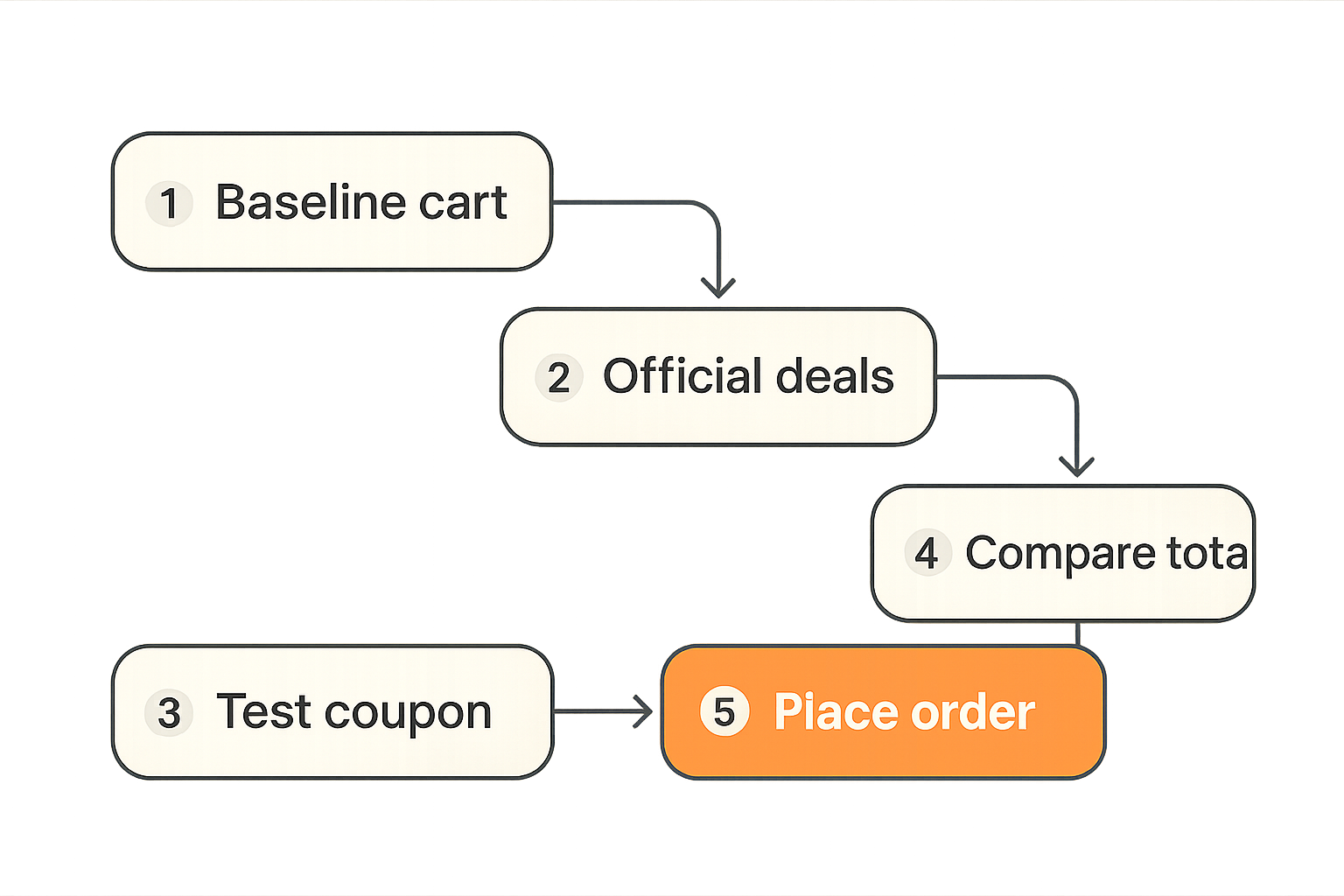
Step 1 price the order without a coupon
Start with a baseline. Build the order you actually want, choose carryout or delivery, select the store, and go far enough to see the subtotal, fees, tax, and estimated tip if delivery.
Write down or mentally note the baseline total. This matters because coupon language can distort your decision. A 30 percent off code may require a larger cart. A free side offer may increase the total if it blocks a better pizza discount.
Use this sequence:
- Select the store or delivery address.
- Build the intended order with no coupon.
- Capture the pre-coupon total.
- Check official deals that require changing the cart.
- Test one coupon at a time.
- Compare final payable totals.
- Place the order only after confirming the best realistic option.
This is not complicated. It is just disciplined.
Step 2 test the best code against the cart
Do not test every code first. Rank them by likelihood.
A high-likelihood Papa Johns coupon has at least three of these traits:
- Recent report date
- Clear order type
- Clear minimum spend
- Clear product category
- Same country or region
- App or web checkout noted
- No claim of impossible stacking
Test the best candidate, then one backup. If both fail, change the cart only if the required change is something you actually want. Buying an extra side to activate a discount is not savings unless the final total and food value make sense.
The mistake teams make is letting the coupon redesign the meal. The coupon should support the order, not hijack it.
Step 3 check total cost not discount size
A bigger discount line can still lose if the basket changed. Compare final totals, not coupon values.
Example:
- Baseline order: $34.20 final total
- Coupon A: $6.00 off, final total $28.20
- Coupon B: 25 percent off after adding another item, final total $31.75
- Automatic deal: final total $27.90
Coupon B sounds strongest. The automatic deal wins.
This is the operator mindset. The metric is not discount percentage. The metric is cost to get dinner handled.
What works when stacking pizza deals
Combine order design with coupon timing
Stacking does not always mean stacking multiple promo codes. Many food checkouts allow only one code. Real stacking usually means combining order design, automatic deals, rewards, payment choices, and timing.
What works:
- Choosing carryout when delivery fees erase the coupon
- Using a menu bundle before testing a code
- Logging into rewards before checkout
- Checking if a local special beats a national code
- Ordering during known promotion windows when available
- Comparing two smaller pizzas versus one specialty pizza if the coupon favors quantity
What fails:
- Applying a code before selecting location
- Assuming delivery and carryout pricing are interchangeable
- Ignoring minimum spend requirements
- Adding unwanted items to unlock a small discount
- Forgetting that tips and fees are part of the real cost
A useful way to think about it is that you are optimizing the order graph. Each choice changes what discounts are available downstream.
Use rewards and gift cards carefully
Papa Rewards and gift cards can help, but they add state. State means things can break or become harder to reconcile.
Rewards are best when you order often enough to use them naturally. They are less useful if you buy more pizza just to chase points. Gift cards can reduce effective cost if purchased at a discount, but they complicate refunds, partial balances, and split payments.
Related reading from our network: encrypted messaging crypto payment architecture is obviously not about pizza coupons, but its payment lesson transfers: keep payment state, settlement, and customer context clean instead of mixing everything in one messy channel.
For shoppers, the simpler version is this: know whether your savings came from the coupon, the rewards balance, the gift card discount, or all three. If you cannot tell, you cannot repeat it.
What fails with Papa Johns coupons
Expired codes and misleading restrictions
Expired codes are the obvious failure. Misleading restrictions are worse because they look valid until the end.
Common restriction traps include:
- Delivery-only or carryout-only language
- Minimum spend before tax but after discounts
- Exclusions on specialty pizzas or sides
- New customer or account-specific offers
- Location exclusions
- App-only or web-only requirements
- One-time use limits
What breaks in practice is late failure. The shopper spends time building the order, reaches checkout, and only then learns the code does not apply. The fix is to test restrictions early with a small representative cart before customizing every topping.
Practical rule: If a code has unclear restrictions, test it before you spend time perfecting the cart.
App browser and location mismatches
Papa Johns coupons can behave differently across app, mobile browser, desktop browser, and third party delivery platforms. Some offers are app-only. Some account offers require login. Some location settings reset when switching devices.
If a code should work but fails, check the boring basics:
- Are you logged into the right account?
- Is the store selected?
- Did the order type switch from carryout to delivery?
- Is the coupon typed exactly as shown?
- Did an automatic deal already occupy the discount slot?
- Is the app updated?
- Are you using a third party delivery checkout where the code is not accepted?
Many failed coupon attempts are not bad codes. They are mismatched checkout contexts.
Over-optimizing until the deal disappears
There is a cost to coupon hunting: time, attention, and sometimes hunger. Over-optimization happens when you chase another 2 percent and lose the better deal, miss a delivery window, or end up ordering something nobody wanted.
Set a stopping rule. For example:
- Test the best two credible codes.
- Compare against the best automatic deal.
- If the difference is under a small amount, choose the simpler checkout.
- Do not add unwanted food for a discount unless the final total still makes sense.
This is where deal hunting becomes practical instead of compulsive.
Track savings like an operator
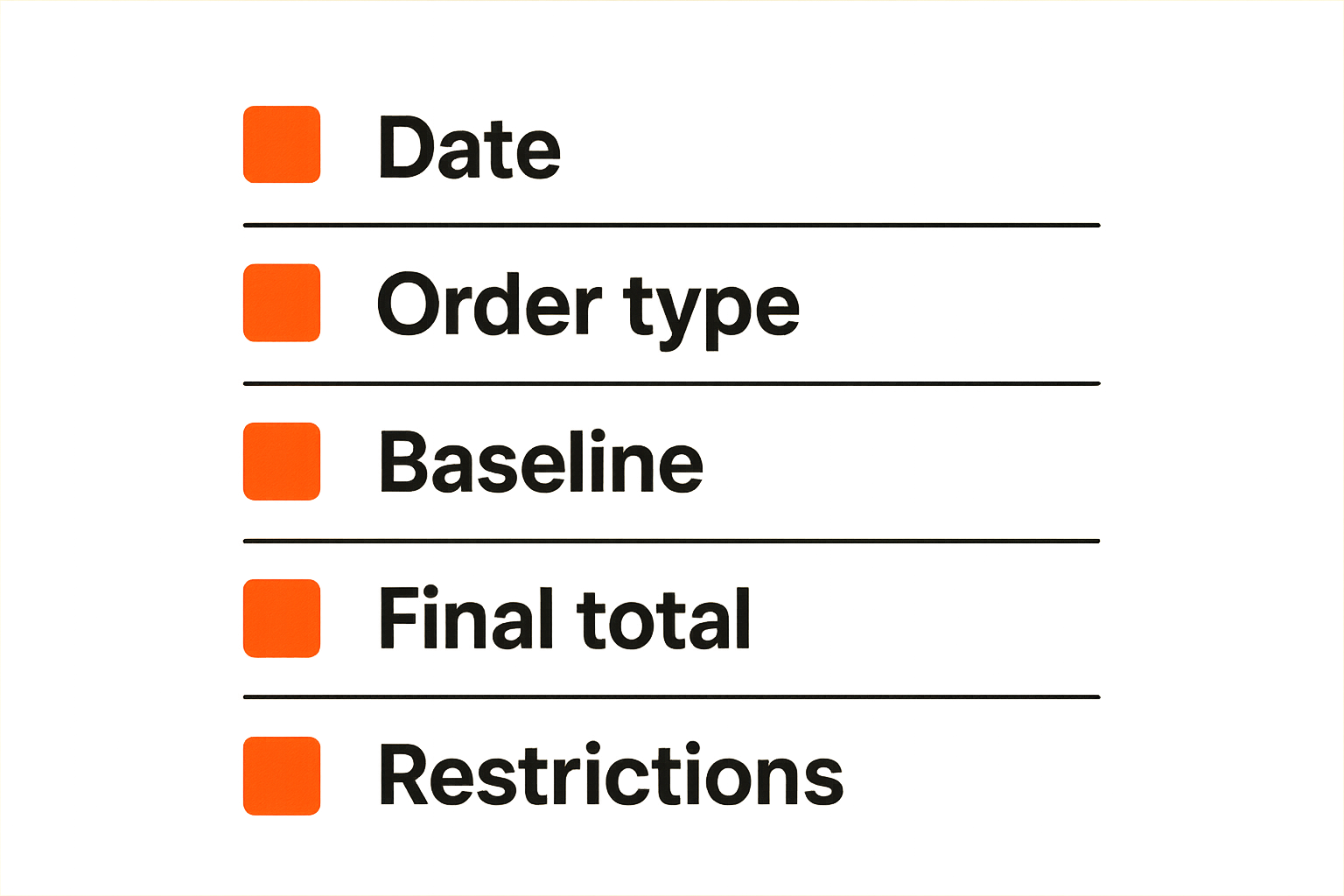
Use a simple coupon log
If you order Papa Johns more than once in a while, keep a tiny log. It can be a notes app entry, spreadsheet, or shared community thread. The point is not bookkeeping perfection. The point is pattern recognition.
Track these fields:
- Date tested
- Code or deal name
- Store region
- Carryout or delivery
- Cart type
- Baseline total
- Final total
- Worked or failed
- Restriction notes
This takes less than a minute after checkout. Over time, you learn which deal types are real for your location and which sources waste your time.
Related reading from our network: encrypted messaging GitHub Actions security covers software workflow controls, but the adjacent lesson applies here: logs are only useful when they capture the context needed to debug the next failure.
Measure effective savings not headline savings
Effective savings means what you actually saved against the order you intended to place. It excludes fake wins created by inflating the basket.
Use this basic formula:
effective savings = intended baseline total - final confirmed total
Then add a note if the order changed. If you added food you wanted anyway, fine. If you added food only to trigger a coupon, the savings number is less clean.
Here is a simple way to classify outcomes:
| Outcome | Meaning | Action |
|---|---|---|
| Clean win | Same order, lower total | Save and share the code context |
| Conditional win | Slight order change, better value | Note the condition clearly |
| Fake win | Bigger discount, higher final total | Ignore next time |
| Failed test | Code rejected or worse than deal | Record restriction if known |
The practical question is whether you can repeat the savings. If not, it was luck, not a system.
Sharing Papa Johns coupons with a community
Share the context not just the code
Coupon communities get better when shoppers submit useful data. A bare code is a weak signal. A tested code with context helps everyone.
When you share Papa Johns coupons, include:
- Date tested
- City or region if comfortable, not your exact address
- Carryout or delivery
- App or web checkout
- Cart summary
- Minimum spend if known
- Whether it stacked with rewards or automatic deals
- Final result
If you find a working code that others should test, you can submit a coupon to the community with enough detail to make it useful instead of another mystery promo.
This is how coupon sharing avoids the expired-code swamp. The community is not just collecting offers. It is maintaining checkout intelligence.
Protect accounts payment details and addresses
Deal sharing should never require oversharing. Do not post full receipts, delivery addresses, phone numbers, order IDs, card details, or account screenshots. If proof is needed, crop aggressively.
The mistake teams make is confusing proof with exposure. You can prove a deal worked without exposing private order data.
A better format is:
- Code: included
- Date: included
- Region: broad
- Order type: included
- Savings: included
- Personal identifiers: removed
That gives the community enough to test while keeping your account safe.
Mobile app web checkout and delivery app tradeoffs
Where the official app usually wins
For Papa Johns coupons, the official app or website is often the cleanest path because it can show account offers, rewards, location-specific deals, and direct coupon validation. It also reduces the number of systems between you and the store.
The official channel is usually better when:
- You have Papa Rewards
- You want to test Papa Johns promo codes directly
- You are choosing carryout
- You want store-specific deals
- You care about direct order support
- You want fewer fee layers
This does not mean the official app always wins. It means it should usually be your baseline.
When third party delivery may still make sense
Third party delivery apps can still be useful if they have their own credits, subscription benefits, payment promos, or delivery availability. But do not assume a Papa Johns coupon will work there. Often, platform-specific promotions and restaurant promo codes are separate systems.
Compare the final totals side by side:
- Official Papa Johns checkout with coupon
- Official checkout with automatic deal
- Third party app with platform credit
- Third party app with subscription delivery benefit
The real answer is local and situational. The workflow stays the same: build comparable carts, include all fees, and choose the lowest reliable total.
Closing make Papa Johns coupons part of the order system
The repeatable rule for Papa Johns coupons
Papa Johns coupons are useful when you stop treating them as magic words and start treating them as checkout inputs. Set the store first. Build the real order. Capture the baseline. Test likely codes. Compare final totals. Record what worked.
That changes the conversation. You are no longer gambling on random promo codes. You are running a lightweight savings workflow that gets faster every time you use it.
The best Papa Johns coupons in 2026 are not always the loudest ones. They are the ones that apply to your cart, your store, your order type, and your final total without creating extra friction.
Try c0upons.com
c0upons.com is for online shoppers who want practical ways to save money with coupon codes, promo codes, sales, and deal roundups. When you are ready to compare offers and share what works, Try c0upons.com.