
Mercari Coupon Codes in 2026: A Practical Workflow for Saving Without Wasting Checkout Time
Mercari coupon codes look simple until you are ten minutes into checkout, rotating through expired codes, seller offers, credits, shipping changes, and app-only prompts that do not behave the way deal posts promised.
Teams think the problem is finding one magic Mercari coupon code. The real problem is building a repeatable savings workflow that protects your time, your total, and your expectations.
That changes the conversation. You are not just hunting for a promo field. You are deciding whether the item price, seller discount, shipping cost, buyer fee, tax, credits, and code eligibility add up to a deal worth buying now.
The practical question is not, Can I find Mercari coupon codes? It is, Can I test them quickly, prove the final price, and avoid paying more because the coupon search distracted me from the actual checkout economics?
Table of contents
- Where Mercari coupon codes actually fit
- The Mercari savings stack
- How to find Mercari coupon codes without chasing dead links
- A checkout workflow for testing Mercari promo codes
- What breaks when Mercari coupon codes are used badly
- Seller offers versus Mercari coupon codes
- Stacking discounts on Mercari without fooling yourself
- Common Mercari coupon code scenarios
- The buyer checklist before you place the order
- How c0upons.com fits into a Mercari savings workflow
- Final takeaways for Mercari coupon codes in 2026
Where Mercari coupon codes actually fit
Mercari is not a normal retail checkout
Mercari is a resale marketplace, not a single-brand store with one pricing team and one promotional calendar. That matters.
On a typical retailer site, the merchant controls the catalog, the promotions, the shipping rules, and the return terms. On Mercari, individual sellers control listing prices and may send offers or accept negotiations. The platform may also run buyer promotions, credits, app campaigns, or targeted discounts.
The mistake teams make is treating Mercari coupon codes like a department-store promo code. They copy a code, paste it into checkout, and assume the only possible outcomes are works or does not work. In practice, the code might be valid but not apply to your account, item category, order minimum, device, payment method, or timing window.
A useful way to think about it is this: Mercari savings are a stack of conditions, not a single discount switch.
The coupon is only one discount layer
A Mercari deal can come from several places:
- The seller priced the item below market.
- The seller accepted a lower offer.
- Mercari gave you account credit.
- A Mercari promo code applied at checkout.
- Shipping was free, bundled, or unusually low.
- You bought at the right time after a price drop.
That means the best deal is not always the order with the biggest coupon. A 10% code on an overpriced listing can still lose to a fairly priced item with no code. The coupon is useful, but it should not control the whole buying decision.
Practical rule: Judge Mercari coupon codes by the final payable total, not by the advertised discount percentage.
Why 2026 shoppers need a workflow
In 2026, deal hunting is faster and noisier. Promo posts spread quickly, app notifications are targeted, and community coupon pages update throughout the day. That is useful, but it also creates bad-code churn.
The practical question is how to test offers without turning every checkout into a research project. Budget-conscious shoppers need a workflow that is simple enough to repeat and strict enough to prevent impulse buys.
Related reading from our network: sellers on freelance marketplaces face similar dependency problems when one platform controls visibility and pricing, which is why this guide to Fiverr alternatives for sellers in 2026 is a useful adjacent read about not relying on one channel or one tactic.
The Mercari savings stack
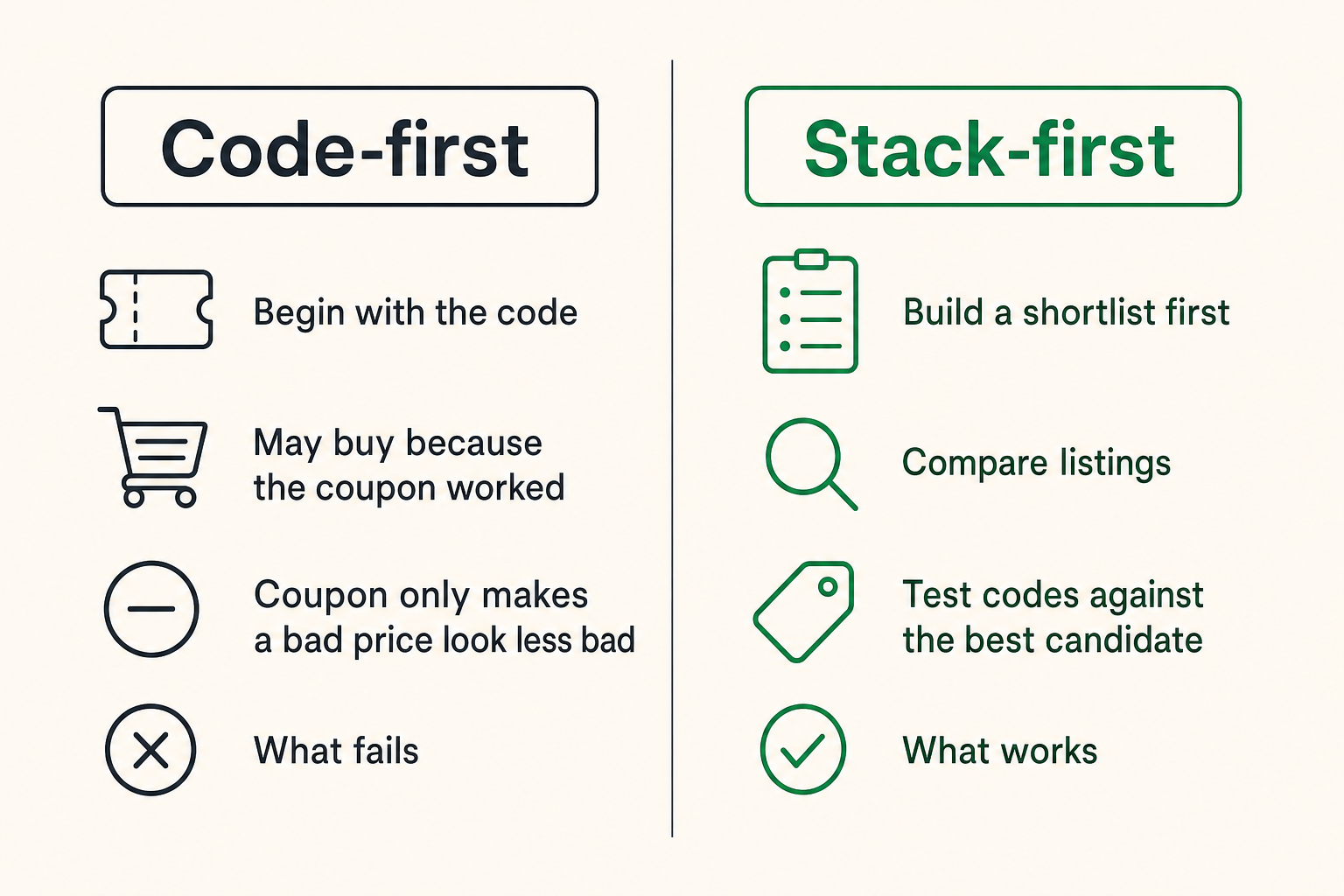
Code, credit, offer, shipping, and timing
The Mercari savings stack has five practical layers.
First, there is the item price. This is the anchor. If the listing is too expensive compared with similar sold items, a coupon may only make a bad price look less bad.
Second, there is the seller offer. This includes offers you send, offers the seller sends, and price drops on watched items. Seller-controlled discounts can be more valuable than platform codes because they reduce the item price before some other costs are considered.
Third, there are Mercari credits or account promotions. These may be targeted, expiration-based, or tied to activity. They often behave differently from public promo codes.
Fourth, there is shipping. Shipping can change the real value of a deal quickly, especially on heavier items. A lower listing price with expensive shipping may lose to a higher listing price with better shipping.
Fifth, there is timing. Many resale deals are perishable. If the listing is rare, waiting for a code can cost you the item. If the listing is common, waiting may give you more leverage.
What works and what fails
What works is separating discovery from checkout. Build a shortlist first. Compare listings. Then test codes against the best candidate.
What fails is code-first shopping. If you begin with the code, you may end up buying an item because the coupon worked, not because the total was good.
Practical rule: A coupon should improve a deal you already wanted. It should not create urgency around an item you had not evaluated.
Related reading from our network: checkout systems in other niches have the same state problem, just with higher stakes; this breakdown of crypto checkout architecture for high-risk merchants is a good parallel for why the visible checkout screen is only one part of the real transaction.
A practical comparison table
| Approach | What the shopper does | What usually happens | Better operating rule |
|---|---|---|---|
| Code-first | Searches for Mercari coupon codes before choosing an item | Wastes time on dead or ineligible offers | Choose the best listing first, then test discounts |
| Listing-first | Compares item condition, seller rating, shipping, and price | Builds a realistic baseline | Only apply codes that improve the final total |
| Seller-offer-first | Sends a reasonable offer before checkout | May reduce the item price directly | Use when the item has room for negotiation |
| Credit-first | Uses expiring Mercari credit on any item | Can trigger a rushed purchase | Use credits only on items that pass your checklist |
| Final-total-first | Compares all costs after discounts | Finds the true cheapest acceptable option | Make the payable total the decision point |
How to find Mercari coupon codes without chasing dead links
Start with source quality
Not all coupon sources are equal. Some pages keep expired codes forever because it creates search traffic. Some scrape old offers with no evidence that anyone used them recently. Some communities are better because shoppers report whether a code worked, failed, or had restrictions.
A useful workflow is to start with a coupon source that lets you search quickly, then cross-check the offer against the checkout page. If you want a broader deal hunt beyond Mercari, use a community coupon search page to search thousands of community-submitted coupon codes and promo deals before you commit time to manual testing.
The mistake teams make is measuring coupon pages by how many codes they list. More codes can mean more noise. For Mercari coupon codes, recency and user feedback are usually more important than volume.
Read the fine print before you copy
Before copying a code, look for these details:
- Minimum purchase amount.
- New-user or existing-user eligibility.
- App-only requirements.
- Category restrictions.
- Expiration date or campaign window.
- Whether the offer is a code, credit, referral, or automatic discount.
- Whether it excludes shipping, tax, buyer fees, or seller offers.
This takes less time than testing six bad codes. It also helps you avoid changing your cart just to satisfy a promotion that was never worth it.
Keep community feedback in the loop
Community feedback is valuable because coupon behavior can vary by account. One shopper may see an app offer that another shopper cannot access. One code may work only for first purchases. Another may require a notification link.
When a community says a Mercari code worked today, that is useful. When several shoppers say it failed because of category restrictions, that is also useful. The goal is not perfect certainty. The goal is reducing wasted checkout attempts.
Related reading from our network: if you like the idea of paths improving based on repeated signals, this technical article on ant colony optimization algorithms for better crawl paths is an adjacent model for how communities can surface better routes over time.
A checkout workflow for testing Mercari promo codes
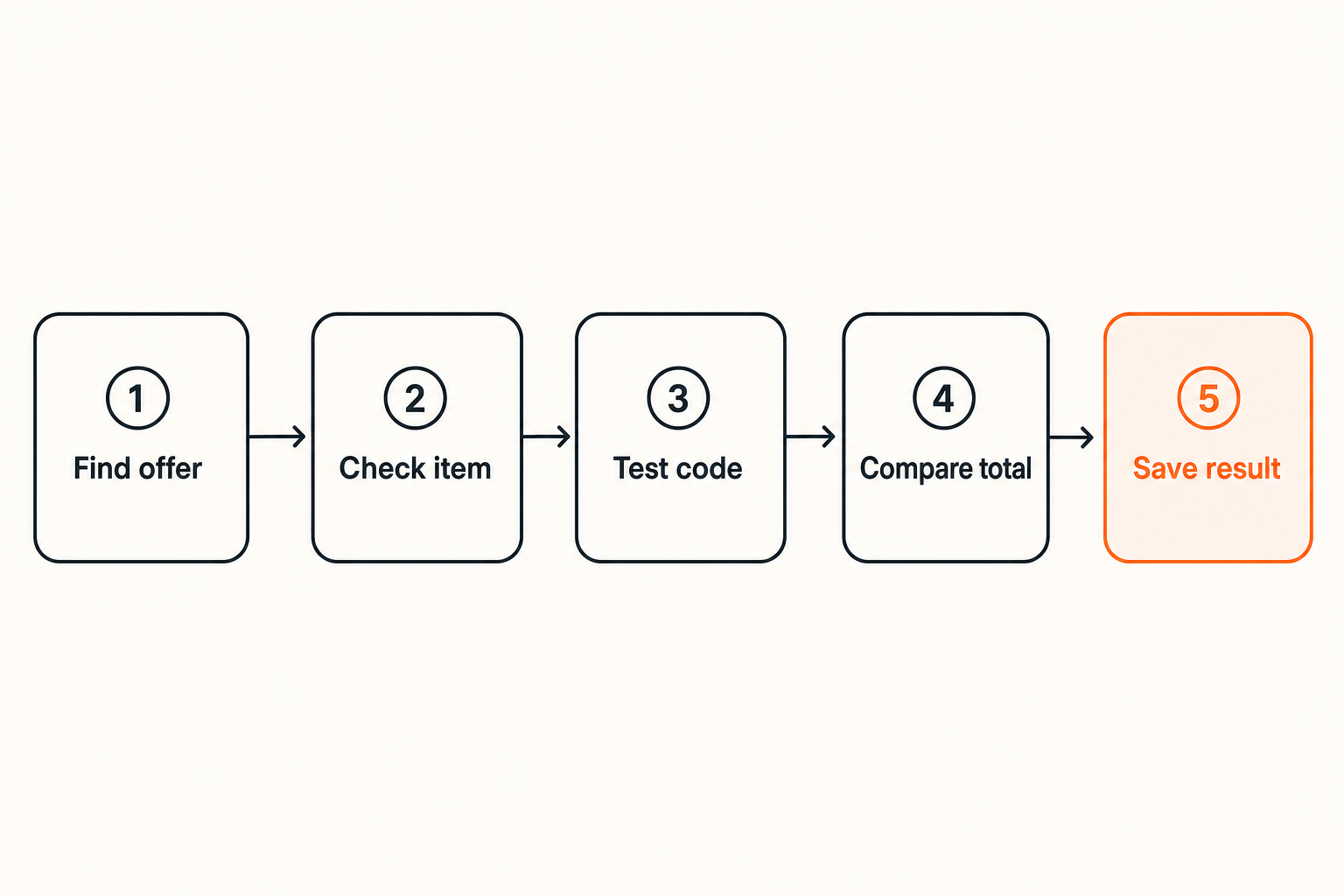
The five-step test sequence
Use a fixed sequence. Do not improvise every time.
- Confirm the item baseline. Check the listing price, condition, seller rating, photos, shipping cost, and comparable sold prices.
- Check seller leverage. Decide whether to send an offer, wait for a price drop, bundle items, or buy now.
- Apply the Mercari coupon code or credit. Enter the code exactly as shown, or activate the offer inside the app if required.
- Compare the final total. Look at item price, shipping, tax, fees, credits, and discount after the code is applied.
- Capture the result. Save the winning total or note why the code failed so you do not retest it later.
That changes the conversation from Did I find a coupon? to Did I improve the order economics?
When to stop testing
There is a point where continued testing costs more than it saves. If you have tried the most recent codes, checked app offers, and compared the final total against other listings, stop.
A good stopping rule is three serious attempts:
- One public Mercari promo code from a current source.
- One account-specific app or credit offer, if available.
- One seller-side move such as an offer or bundle request.
If none improves the final total enough, either buy at the baseline price or walk away.
Practical rule: If a discount test changes your buying decision but not your final value, it is not saving you money. It is creating checkout noise.
How to document the winning total
This does not need to be complicated. Use a note on your phone, a screenshot, or a simple comparison format:
Item: Vintage jacket
Listing price: $48
Shipping: $7.99
Seller offer: Accepted at $42
Mercari code: Not eligible
Credit: $5 applied
Final total before tax: $44.99
Decision: Buy if condition photos look clean
The point is not bookkeeping for its own sake. The point is preventing the common trap where you remember the coupon but forget the shipping.
What breaks when Mercari coupon codes are used badly
Expired-code churn
Expired-code churn is the most obvious failure mode. You find a promising page, copy a code, paste it into checkout, get rejected, repeat. After four attempts, you are annoyed and more likely to buy just to end the process.
What breaks in practice is judgment. The checkout process becomes a slot machine. Maybe the next code works. Maybe the next page has the real one. Meanwhile, the original listing may not even be the best available option.
The fix is simple: use recency, feedback, and stopping rules. If a code source does not show signs of being maintained, treat it as low-confidence.
Item eligibility surprises
Mercari promotions may be limited by category, minimum order value, account type, device, or campaign terms. A code that works for one buyer may fail for another.
This is frustrating, but it is not unusual. The practical response is to verify eligibility before you emotionally commit to the discount. If the code requires a $50 minimum and your item is $42, do not add an unwanted accessory just to qualify unless the combined order still makes sense.
The mistake teams make is expanding the cart to serve the coupon. The coupon should serve the cart.
Shipping and fee blind spots
Shipping and fees are where many Mercari savings calculations break. A coupon may reduce the item price but leave shipping untouched. A seller offer may lower the item price but not make the order cheaper than another listing with better shipping.
Always compare the payable total. If you are choosing between two listings, do not compare listing price to listing price. Compare final total to final total.
Seller offers versus Mercari coupon codes
Seller-controlled discounts
Seller offers are often underused because they feel slower than pasting a code. But on resale marketplaces, negotiation is part of the system.
A seller-controlled discount can come from:
- Your offer to the seller.
- A seller sending an offer to likers.
- A seller lowering the public listing price.
- A bundle discount on multiple items.
These discounts are tied to the listing itself. They may be more reliable than a public promo code because the seller can accept, reject, or counter. You get a clear answer.
Platform-controlled promotions
Mercari coupon codes and platform credits are controlled by Mercari. They may be broader, but they are also more conditional. The offer might be targeted to your account. It might require the app. It might expire before the seller responds.
That does not make platform promotions bad. It means you need to fit them into the workflow correctly. If you have a short-lived Mercari credit, prioritize listings where you already know the item, condition, and price range.
Negotiation rules that save time
Use a reasonable offer. Lowballing can waste time and cause sellers to ignore you. A practical offer is usually anchored in comparable prices, item condition, and how long the listing has been active.
Do not ask the seller to solve the coupon problem. Sellers typically cannot make a Mercari promo code work for your account. They can adjust their listing price, shipping setup, bundle terms, or acceptance of your offer.
Practical rule: Use seller negotiation to change the listing economics. Use Mercari coupon codes to change the checkout economics. Do not confuse the two.
Stacking discounts on Mercari without fooling yourself
Calculate from the final payable amount
Stacking sounds good, but bad stacking math is common. A shopper sees a seller offer, a credit, and a coupon, then mentally adds the advertised discounts together. Checkout rarely behaves that cleanly.
The better method is sequential:
- Start with the current listing total.
- Apply seller price changes.
- Add shipping and visible fees.
- Apply credits or coupon discounts as checkout allows.
- Compare the final payable amount against your baseline.
If the final total is lower, you saved money. If the final total is still higher than another listing, the stack is not good enough.
Use credits carefully
Credits feel like free money, so shoppers spend them too quickly. But a $10 credit used on a weak listing may be less valuable than the same credit used on an item you already planned to buy.
Check the expiration date, minimum spend, and whether the credit applies automatically. If a credit is expiring today, that can justify faster action, but it should not override basic listing checks.
Avoid fake stacking math
Fake stacking math happens when each discount is calculated against a different baseline. For example, you might say you saved $15 from a seller offer and $10 from a credit, but if shipping increased or another listing was already $20 cheaper, the real savings are smaller.
Use one baseline: the best acceptable alternative available right now. That might be another Mercari listing, another resale marketplace, or skipping the purchase.
Common Mercari coupon code scenarios
First purchase and account promotions
New-user offers are common across marketplaces, but they are not always available, and they may change. If you are a first-time Mercari shopper, check whether the promotion is automatically attached to your account or requires a specific code.
Do not create account confusion just to chase a one-time discount. Account eligibility, payment method verification, shipping addresses, and marketplace rules matter. Keep it clean and simple.
App-only and notification offers
Some Mercari promotions may appear through the app, push notifications, email, or account banners. These can be easy to miss if you only search the web.
Before checkout, check:
- App notifications.
- Account credits.
- Email offers from Mercari.
- Cart or checkout banners.
- Listing-page prompts.
If an offer is app-only, test it in the app. Do not assume the desktop site will behave the same way.
Category and minimum-spend offers
Category restrictions can be useful if they match what you are buying. They are a trap if they push you into a category you did not plan to shop.
Minimum-spend offers need the same discipline. If a code gives $10 off $50, and your desired item is $44, adding a $12 item you do not need is not automatically smart. You spent more cash to unlock a discount. Sometimes that makes sense for bundles. Often it does not.
The buyer checklist before you place the order
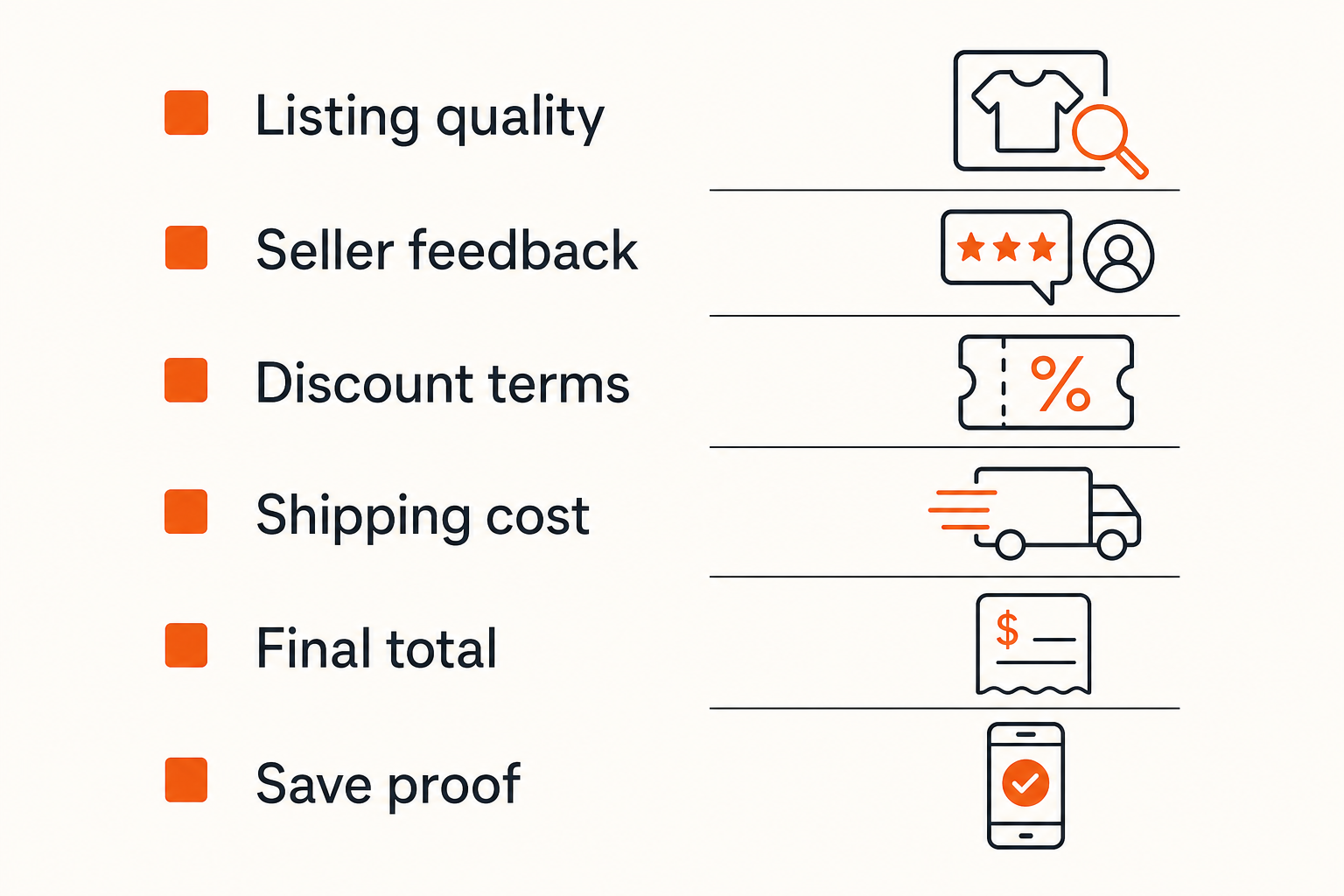
Verify the listing
Before you let a Mercari coupon code influence your decision, verify the listing itself.
Check the photos closely. Look for signs of wear, missing accessories, unclear sizing, stock images, or vague descriptions. Read the seller profile and recent feedback. Confirm that the item condition matches the price.
For electronics, collectibles, shoes, bags, and higher-ticket items, slow down. A coupon does not fix authenticity risk, missing parts, or poor seller communication.
Verify the discount
Once the listing passes, verify the discount.
Ask these questions:
- Did the Mercari coupon code apply successfully?
- Did the discount amount match the terms?
- Did it apply to the item price only or the whole order?
- Did any other credit disappear when the code was added?
- Is the code tied to a payment method, device, or account condition?
If the answer is unclear, remove the code and compare totals again. Sometimes a code can make checkout look better while replacing another benefit.
Verify the total
The final total is the truth. Not the listing price. Not the coupon percentage. Not the savings message.
Verify the full payable amount before placing the order. If you are comparing multiple listings, write down the totals. The winner should be the item that meets your quality requirements at the best final price, not the item with the most dramatic promo message.
How c0upons.com fits into a Mercari savings workflow
Use community data as a filter
Coupon sites are most useful when they reduce the number of bad tests. That is the role c0upons.com should play in a Mercari workflow: not as a magic-code machine, but as a filter for current, community-submitted offers.
If you are checking Mercari coupon codes, look for signs that a code is fresh, specific, and reported by real shoppers. Then test it against your checkout total. The workflow still matters. The community data simply helps you start from a better candidate set.
This is also why broad deal habits transfer across stores. The same discipline you use on Mercari applies to fashion, electronics, groceries, travel, and resale marketplaces: find the offer, read the terms, test the total, and walk away if the math fails.
Share working codes back
Deal communities get better when shoppers report what actually happened. If a Mercari code worked, share the code, the date, and any restrictions you noticed. If it failed, report that too.
You can submit coupon codes and deals updated by the community when you find a working offer, especially if the terms are clearer after checkout than they were in the original promotion.
Useful feedback includes:
- Worked or failed.
- Date tested.
- Minimum spend.
- App-only or desktop.
- New-user or existing-user.
- Category restriction.
- Whether it stacked with credits.
Keep the workflow portable
The best savings workflow should work beyond Mercari. You should be able to use the same method on retailer stores, delivery apps, travel booking sites, and marketplaces.
The portable version is simple:
- Define the item you actually want.
- Find the best baseline price.
- Test only relevant coupons.
- Compare final totals.
- Share what worked so the next shopper wastes less time.
That is practical, community-minded deal hunting. It respects your budget and your time.
Final takeaways for Mercari coupon codes in 2026
The short version
Mercari coupon codes can save money, but they are not the whole system. The real savings come from combining listing evaluation, seller offers, platform credits, shipping awareness, and final-total discipline.
The mistake teams make is chasing codes before they understand the order. Flip the sequence. Pick the right listing first. Then use coupons to improve the price.
The rule for deal hunters
If a Mercari promo code applies cleanly and lowers the final payable amount on an item you already wanted, use it. If it requires extra spending, weakens your judgment, or distracts you from seller quality and shipping, skip it.
Mercari coupon codes are useful tools in 2026, but the winning workflow is still simple: verify the item, test the discount, compare the final total, and only buy when the deal holds up.
Try c0upons.com
You are writing for online shoppers who want practical ways to save money with coupon codes, promo codes, sales, and deal roundups. Try c0upons.com.