Encrypted Messaging Coupon Codes: A Practical Guide to Private Deal Sharing in 2026
Encrypted messaging coupon codes sound simple: someone drops a promo code in a private chat, everyone saves money, and the group moves on.
That is not what usually happens.
What happens in real life is messier. A code is posted without the store name. Someone says it worked, but not for the same cart. Another person forwards a screenshot with an order number still visible. A few hours later, the coupon is dead, the thread is full of noise, and nobody knows whether the deal was real, expired, region-locked, account-specific, or just badly copied.
Teams think the problem is finding more coupon codes. The real problem is building a reliable private deal-sharing workflow. That changes the conversation. Encrypted messaging protects the conversation, but it does not verify the discount, organize the terms, remove personal data, or help a shopper decide whether a code is worth trying.
This guide treats encrypted messaging coupon codes as a practical shopping system: how to share them, verify them, avoid common mistakes, and keep private deal groups useful instead of chaotic.
Table of contents
- Why encrypted messaging coupon codes are a workflow problem
- What counts as encrypted messaging coupon codes
- The privacy versus savings tradeoff
- Build a coupon verification workflow
- How to share deals without leaking more than needed
- Where encrypted messaging coupon codes fail in practice
- A practical shopper workflow for 2026
- Comparison: public coupon hunting versus encrypted deal sharing
- Community rules that keep private coupon groups useful
- Where c0upons.com fits into the workflow
Why encrypted messaging coupon codes are a workflow problem
Coupon sharing moved into private chats
Deal hunting used to be mostly public. You searched the web, checked a coupon site, tried a few promo codes, and moved on. That still works, but shoppers now also trade discounts in encrypted group chats, family threads, workplace channels, private communities, and niche shopping circles.
That shift makes sense. Some offers are time-sensitive. Some are tied to loyalty emails. Some appear first in small communities before they reach a broader coupon database. If a friend says a 25% code worked ten minutes ago, that feels more useful than a stale code from an old forum thread.
The mistake teams make is assuming private means better. Private can mean faster. It can mean more trusted. It can also mean harder to search, harder to verify, and easier to misuse.
Privacy changes the discount hunt
Encrypted messaging is useful because the conversation is not casually exposed to the platform operator or the open web. For shoppers who care about privacy, that matters. You may not want your purchase plans, medical categories, travel dates, children’s products, or location-specific offers floating around public comment threads.
But privacy also removes some of the natural checks that public coupon communities provide. Public pages often have voting, timestamps, comments, merchant names, expiration notes, and enough volume to spot patterns. Private chats usually have trust, but less structure.
A useful way to think about it is this: encryption protects the room. It does not organize the room.
Separate secrecy from savings
Encrypted messaging coupon codes should not be treated as magic codes that are safer or more valuable just because they came through a private app. The practical question is whether the code is valid, whether you are eligible, whether the discount changes the final total, and whether using or sharing it exposes anything you would rather keep private.
Practical rule: Treat every private coupon code as unverified until someone reports the store, terms, test time, cart conditions, and final checkout result.
That one rule saves shoppers from most private-chat coupon problems.
What counts as encrypted messaging coupon codes
One-to-one codes, group drops, and screenshots
Encrypted messaging coupon codes usually show up in three formats.
First, there are direct text codes: a friend sends SAVE20, WELCOME15, or a similar promo string in a message. These are easiest to test and easiest to copy correctly.
Second, there are group drops: someone posts a deal in a private shopping group with a store name, code, link, and short note. These can be useful if the group has rules. Without rules, they become a scrolling feed of guesses.
Third, there are screenshots. Screenshots are common because many offers arrive by email, app notification, or loyalty dashboard. Screenshots are also risky because they often include names, email addresses, loyalty numbers, order IDs, shipping cities, QR codes, or personalized URLs.
The safer format is plain text plus relevant terms. Screenshots should be the exception, not the default.
Account-specific versus public promo codes
Not all codes are meant to work for everyone. Many coupons fall into one of these buckets:
| Code type | Typical source | Transferable? | Shopper risk |
|---|---|---|---|
| Public promo code | Coupon site, merchant banner, public email | Often | Low |
| Loyalty code | Rewards email or app | Sometimes | Medium |
| Account-specific code | Personalized offer | Often no | Medium |
| Referral code | Customer referral program | Usually yes, with terms | Medium |
| One-time code | Support credit, apology offer, unique email | Usually no | Higher |
| Screenshot-only deal | App, SMS, QR, loyalty wallet | Depends | Higher |
The important distinction is not only whether the code works. It is whether the code was meant to be shared. A public code can usually be circulated without much concern. A one-time account credit may fail for everyone else, or worse, reveal details about the original shopper.
Why source context matters
A code without source context wastes time. If someone posts ONLYTODAY with no store, no category, no expiration, and no cart minimum, the group has to reverse-engineer the deal. That is not deal hunting. That is unpaid debugging.
A useful post includes:
- Store or marketplace name
- Promo code exactly as entered
- Discount amount or percentage
- Cart minimum, if known
- Product category restrictions
- Expiration date or time window
- Whether it was email, app, SMS, or public banner
- Whether it worked at checkout or only appeared in cart
This does not require a long write-up. It requires discipline.
The privacy versus savings tradeoff
What encryption does and does not solve
Encryption helps protect messages in transit and, depending on the app design, may limit who can read message content. That is valuable. For this guest contribution, the team at qrypt.chat looks at coupon sharing through the same practical lens used for private communication: reduce unnecessary exposure, assume forwarding happens, and design the workflow around what people actually do.
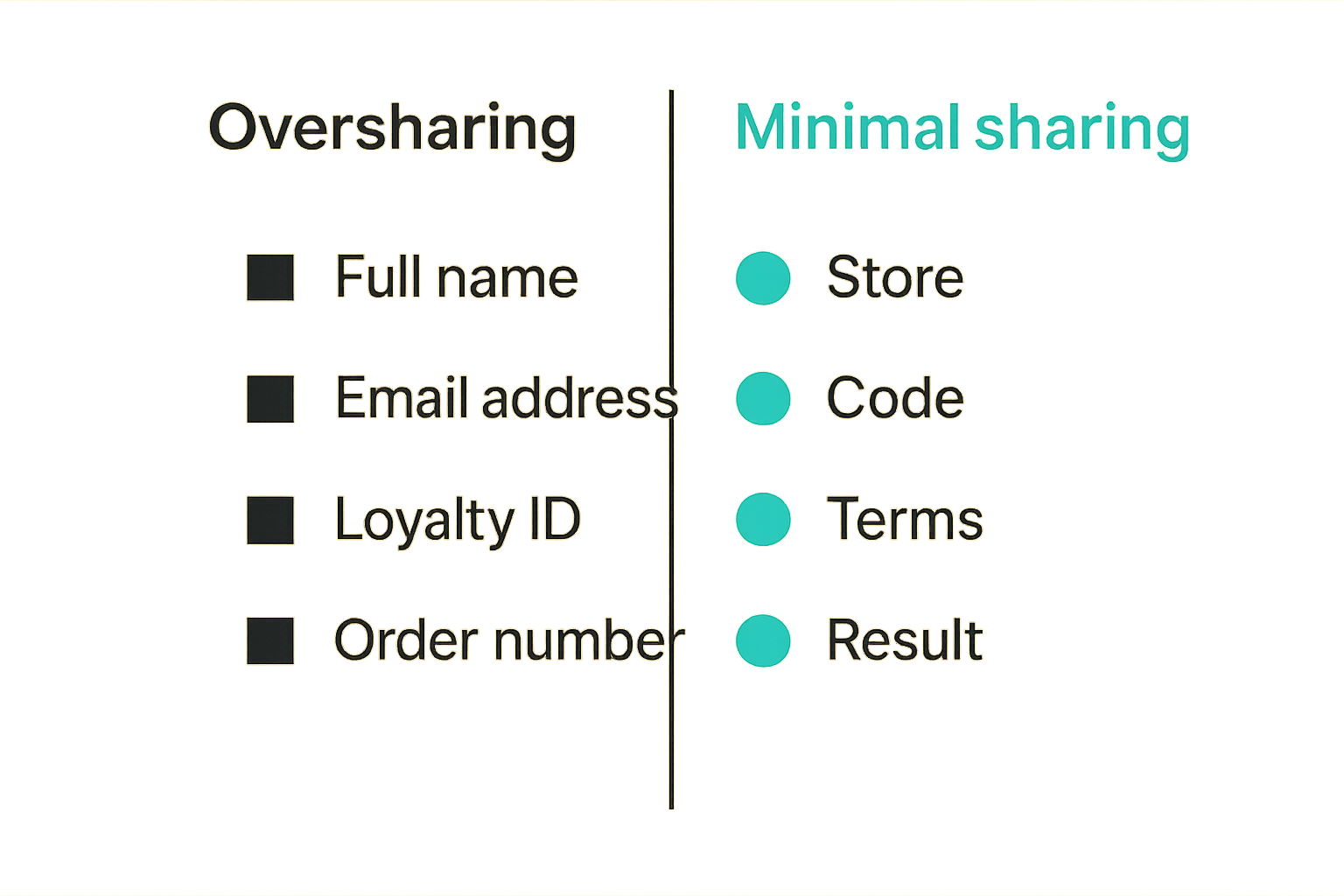
What encryption does not solve is human oversharing. If you post a screenshot with your full name, email address, loyalty ID, order number, and delivery ZIP code, encryption only protects that data inside the group. Every group member can still see it. Anyone can still screenshot it. Someone can still forward details manually.
The practical question is not whether your messaging app is private in theory. The practical question is what information you put into the message.
The data shoppers accidentally leak
Coupon posts often reveal more than the code. Common leaks include:
- Email address visible in a promotional email
- Full name shown in account dashboards
- Loyalty or membership number
- Order number from a prior purchase
- Shipping address or ZIP code
- Partial card details from checkout screens
- Personalized link with tracking tokens
- Purchase intent for sensitive categories
- Children’s names in family product accounts
- Travel dates in hotel, airline, or rental car deals
What breaks in practice is that shoppers focus on hiding the payment card but leave everything else visible. That is too narrow. Your order ID, loyalty number, and personalized link can still be sensitive.
A safer sharing standard
The standard should be simple enough for a normal shopper to follow.
Practical rule: Share the minimum needed to help another shopper test the discount: store, code, terms, timing, and result. Remove everything that identifies you.
If a screenshot is necessary, crop it tightly. If cropping is not enough, redact it. If redaction feels like too much work, rewrite the offer as text instead.
The best private deal groups do not rely on everyone being a security expert. They rely on easy norms: no full email screenshots, no order pages, no account dashboards, no unredacted QR codes, and no personalized links unless the sender clearly explains what they are.
Build a coupon verification workflow
Step 1: Capture the deal cleanly
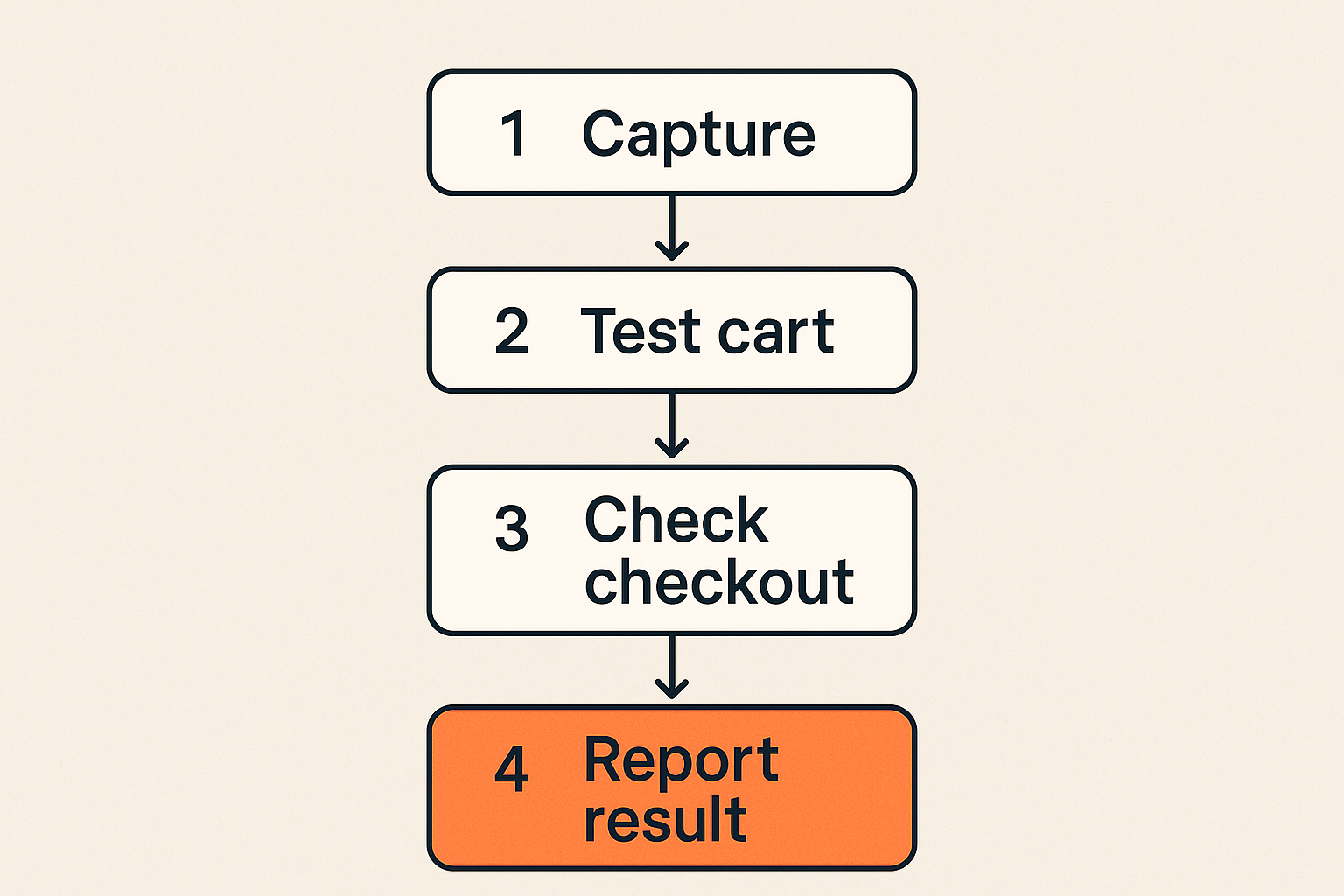
A coupon verification workflow starts before anyone tests the code. The first person who finds the offer should capture it in a clean format.
Use this basic template:
- Store: Merchant name
- Code: Promo code or no-code offer
- Discount: Amount or percentage
- Minimum spend: If known
- Category: If restricted
- Source: Public page, email, app, SMS, referral, loyalty
- Expiration: Date, time, or unknown
- Tested: Not yet, cart, or checkout
This template matters because private chats are bad databases. Search works only if people use consistent words. If every deal starts with the store name and code, the group can find it later.
Step 2: Test without exposing personal details
Testing should happen with the least personal information possible. In many stores, you can add items to cart and apply a promo code before entering full payment information. That is the safest first test.
A sensible test sequence looks like this:
- Open the merchant site or app directly.
- Add an eligible item to cart.
- Apply the code before logging in, if the store allows it.
- Check whether the discount appears in cart.
- Continue only far enough to see whether the discount survives checkout conditions.
- Stop before payment unless you intend to buy.
- Report the result back to the group.
This avoids turning every coupon test into a full account or payment exposure event.
Step 3: Report the result in a standard format
The group needs feedback, not vague reactions. Worked for me is better than silence, but it is still incomplete. Worked on what? At what time? In which country? Before or after login? On sale items or full-price items?
A better result report is short:
- Worked: yes, no, or partial
- Time tested: today, with timezone if relevant
- Cart: product type and approximate subtotal
- Condition: guest checkout, logged in, app only, new customer, loyalty member
- Final status: cart only or checkout confirmed
Practical rule: A coupon is not verified until at least one shopper confirms the discount at the final checkout step, not just in the cart.
Many codes appear in cart and disappear later when shipping, region, account age, or excluded items are calculated. The final checkout step is where reality shows up.
How to share deals without leaking more than needed
Redact before posting
Redaction is not just for serious documents. It is a basic shopping habit when sharing private offers.
Before posting a screenshot, remove:
- Your name
- Email address
- Phone number
- Loyalty ID
- Order number
- Shipping address
- Payment details
- Tracking links
- QR codes unless needed
- Any item that reveals something personal unnecessarily
Use built-in markup tools carefully. Some highlighter tools do not fully hide text if the image is edited later. A solid block or crop is safer than a translucent marker.
The mistake teams make is assuming a private group is a safe place for raw screenshots. It may be safer than a public forum, but it is still a group of people with cameras, backups, notifications, and forwarding habits.
Avoid forwarding mystery links
A coupon link can be useful, but a mystery link in a private chat creates avoidable risk. It may contain tracking parameters, affiliate tags, session identifiers, referral IDs, or personalized tokens. It may also be copied from a redirect chain rather than the merchant’s actual page.
For most shoppers, the safer pattern is:
- Name the store.
- Share the code.
- Describe the path: homepage banner, app inbox, rewards tab, email offer.
- Let others navigate directly to the merchant.
If the link is required, explain why. For example: This offer only opens from the app inbox link, or referral link required by merchant terms. Context helps people decide whether to click.
Keep identity and eligibility separate
Some coupons depend on who you are: student, teacher, military, healthcare worker, new customer, loyalty member, regional shopper, cardholder, or app user. There is nothing wrong with eligibility-based discounts. The problem is oversharing proof.
If a code is student-only, say student verification required. Do not post your student portal screenshot. If a discount requires a credit card issuer offer, say card-linked offer may be required. Do not post your card dashboard.
The goal is to separate eligibility information from identity documents. Private coupon sharing should help shoppers understand whether they qualify, not encourage people to expose personal proof in a group chat.
Where encrypted messaging coupon codes fail in practice
Expired codes keep circulating
The biggest operational failure is stale information. A public coupon page can be updated. A private message thread keeps old posts alive forever unless someone actively cleans them up.
Expired codes waste time because people keep discovering them through search, forwarded screenshots, or pinned messages. This is especially common around seasonal sales, flash offers, and app-only promotions.
A simple fix is to label stale deals clearly. If a code dies, reply to the original post with expired or no longer working. If the group supports message editing, update the original. If the group uses pinned posts, remove dead codes quickly.
Practical rule: Every private coupon group needs a dead-code habit. If a code fails twice under reasonable conditions, mark it expired or unverified.
Screenshots hide the actual terms
Screenshots feel trustworthy because they look like proof. They can also hide the most important terms. The visible part might say 30% off, while the cropped section says excludes sale items, valid only in app, expires at midnight Eastern time, or one use per account.
What breaks in practice is that shoppers copy the headline and miss the conditions. Then the group argues about whether the code works when the real issue is eligibility.
If you share a screenshot, include a text summary of the terms. If you receive a screenshot without terms, ask for them before spending time building a cart around the discount.
Private groups become noisy fast
Private deal groups often start with high trust and low volume. Then more people join, more stores are posted, and the signal drops. Birthday codes, referral links, region-locked offers, expired screenshots, and repeated questions all land in the same feed.
Noise is not just annoying. It reduces savings because good deals get buried.
The fix is not to ban conversation. The fix is to separate deal posts from discussion where possible. Some groups use one thread for verified codes and another for questions. Others require a standard format for all new deals. The exact tool matters less than the habit.
A practical shopper workflow for 2026
Start public, then validate privately
Encrypted messaging coupon codes work best when they complement public coupon search instead of replacing it. Start with a public coupon source to establish the baseline: current codes, common exclusions, store-wide sales, free shipping thresholds, and seasonal patterns.
Then use private chats for context: Did this work today? Did it stack with the sale? Is it app-only? Did anyone get it to work on clearance items? Is there a better loyalty offer?
That sequence is more efficient than throwing random private codes at checkout. Public search gives breadth. Private groups add recent experience.
Use a simple deal template
Here is a practical template shoppers can copy into a private chat:
Store:
Code:
Discount:
Minimum spend:
Category:
Source: public / email / app / SMS / loyalty / referral
Expires:
Tested: cart / checkout / not tested
Notes:
The template is boring on purpose. Boring is good when you are trying to save money. It makes deals searchable, comparable, and easier to verify.
For example:
Store: Example Outdoor
Code: TRAIL20
Discount: 20% off
Minimum spend: $75
Category: hiking gear, excludes clearance
Source: email, appears public after login
Expires: June 15
Tested: checkout
Notes: worked on boots, did not stack with free shipping code
No personal data. No order number. No screenshot needed.
Close the loop after checkout
The workflow is not finished when someone posts a code. It is finished when shoppers report outcomes.
A useful close-the-loop reply looks like:
- Worked at checkout on $82 cart
- Failed on sale items
- App only
- New customers only
- Expired today
- Stacked with free shipping
- Did not stack with rewards credit
This feedback turns a private chat from a rumor feed into a working coupon database. It also helps budget-conscious shoppers avoid wasting twenty minutes chasing a discount that was never likely to apply.
Comparison: public coupon hunting versus encrypted deal sharing
What works in public coupon search
Public coupon search is still the right starting point for most purchases. It gives shoppers visibility across stores, categories, and seasonal campaigns. It is also easier to scan than a private thread.
Public pages are especially useful for:
- Common merchant promo codes
- Store-wide sales
- Free shipping thresholds
- Holiday deal roundups
- First-order discounts
- Category promotions
- Codes that many shoppers can test
The practical advantage is scale. If many shoppers are checking and using similar codes, bad information is easier to spot.
What works in private coupon groups
Private groups are better for context and timing. They can surface a deal quickly, especially when shoppers have similar interests. A parent group may know which children’s store code stacks with a clearance event. A local community may know which grocery delivery promo works in a specific city. A hobby group may notice a niche brand sale before it spreads widely.
Private groups are also useful when shoppers want discretion. Not every purchase plan belongs in a public comment section.
Here is the clean comparison:
| Factor | Public coupon hunting | Encrypted deal sharing |
|---|---|---|
| Best use | Broad code discovery | Recent context and trusted feedback |
| Searchability | Usually better | Depends on group habits |
| Privacy | Lower if posting publicly | Higher inside the group |
| Verification | Can benefit from many users | Can benefit from trusted users |
| Noise risk | Duplicate or outdated pages | Chat clutter and stale screenshots |
| Main failure | Old or generic codes | Unstructured private posts |
| Best workflow | Check before checkout | Confirm edge cases and results |
Neither model wins every time. The practical answer is to use both for different jobs.
What fails in both models
Both public and private coupon hunting fail when shoppers skip verification. A code that worked last week may not work today. A code that works for a new customer may fail for an existing customer. A code that works in one region may fail in another. A code that appears in cart may disappear at final checkout.
The same rule applies everywhere: test the final price, not the headline discount.
Also watch for fake urgency. Many stores use countdowns, limited-time banners, and aggressive sale language. A private message saying hurry does not make the offer better. It just makes people test less carefully.
Community rules that keep private coupon groups useful
Make verification a group habit
Good private coupon communities are not built on luck. They are built on small operating rules.
Use rules like:
- New deal posts should include store, code, discount, source, and expiration.
- Screenshots must be cropped or redacted.
- Referral links must be labeled.
- Account-specific codes should be marked as possibly targeted.
- Dead codes should be reported in replies.
- Pinned posts should contain only currently useful deals.
These rules do not need to feel strict. They protect the group from becoming useless.
Limit sensitive categories
Some shopping categories deserve extra care: health, fertility, legal services, financial products, children’s items, travel, identity verification services, and anything tied to a sensitive life event.
That does not mean shoppers should never share deals in those categories. It means they should share less personal context. Store, discount, and terms are usually enough. The group does not need diagnosis details, travel companions, case numbers, insurance screenshots, or full account pages.
A good rule is: if the category is sensitive, use text instead of screenshots unless there is no alternative.
Rotate maintainers and remove stale posts
Large private groups need maintenance. Someone has to remove stale pinned deals, remind people to redact screenshots, and mark dead codes. If that work falls on one person forever, it stops happening.
Rotate the role informally. One person can maintain pins during a holiday sale week. Another can clean up a back-to-school thread. A third can summarize verified codes at the end of the day.
This is not bureaucracy. It is how a coupon community stays useful.
Where c0upons.com fits into the workflow
Use public coupon pages as the baseline
The smartest way to use encrypted messaging coupon codes is to avoid making private chats do every job. Use public coupon pages to find the baseline first: known promo codes, current sales, store offers, and deal patterns. Then use private chats to answer the questions public pages may not answer quickly enough.
For example:
- Check current public codes before building your cart.
- Apply the best available code.
- Ask a trusted private group if anyone has a better recent result.
- Test any private code safely.
- Report whether it worked.
- Save the final verified result for the next shopper.
That workflow reduces guesswork. It also keeps private groups from turning into messy search engines.
Use private chats for context, not chaos
Encrypted messaging is best for human context: this worked today, this failed on sale items, this appears app-only, this might be targeted, this is not worth chasing. It is not best for long-term organization unless the group has strong habits.
c0upons.com fits as the public starting point for shoppers who want practical coupon codes and deal discovery before they ask a private group to validate edge cases. Private chat then becomes a second layer, not the whole system.
That is the practical answer for 2026. Encrypted messaging coupon codes can help shoppers save, but only when they are shared with enough context, tested carefully, and stripped of personal data before posting. Privacy and savings work together when the workflow is clean.
Try c0upons.com
Find practical coupon codes, promo codes, sales, and deal roundups for smarter shopping: Try c0upons.com.