
DICK'S Sporting Goods Coupon Code Workflow: How to Save More Without Wasting Checkout Time
A DICK'S Sporting Goods coupon code looks simple until you are twenty minutes into checkout, switching tabs, copying dead codes, and trying to figure out why the best-looking discount does nothing to your cart.
Shoppers think the problem is finding a DICK'S Sporting Goods coupon code. The real problem is building a checkout workflow that separates real savings from noise.
That changes the conversation. The practical question is not which code has the biggest percentage in the headline. It is which combination of sale price, promo code, rewards, shipping method, gift card, and timing produces the lowest payable total for the gear you actually plan to buy.
The mistake shoppers make is treating coupon codes like magic strings. In production shopping, they behave more like rules. They have exclusions, channels, thresholds, fulfillment constraints, account requirements, and expiration windows. If you do not test those rules in a clean way, you can end up chasing discounts that never applied to your order in the first place.
Table of contents
- The real problem with a DICK'S Sporting Goods coupon code
- Build a discount stack before you search
- Where to find a DICK'S Sporting Goods coupon code without wasting time
- Validate a DICK'S Sporting Goods coupon code at checkout
- Stacking rules that matter for sports retail
- A practical 2026 workflow for deal hunters
- What breaks when coupon codes are used badly
- What works and what fails
- Edge cases: pickup, oversized gear, and returns
- Use c0upons.com as a savings workflow, not a last click
The real problem with a DICK'S Sporting Goods coupon code
The visible code is only one input
A coupon code is not the deal. It is one input into the checkout system. The same code can behave differently depending on product category, brand, account status, minimum order value, delivery method, and whether the item is already discounted.
That is why the biggest advertised promo is often not the best result. A 20 percent code that excludes your running shoes is worth less than a smaller shipping offer that applies cleanly to the exact order. A useful way to think about it is this: the coupon headline is marketing, but the cart total is the operating data.
Why 2026 shopping makes validation harder
In 2026, retail discounting is more fragmented. Shoppers see email-only offers, app promos, member rewards, limited-time sales, clearance pricing, payment card offers, cashback portals, and community-submitted promo codes. None of those layers is bad. What breaks in practice is assuming they all stack without conflict.
Sports retail is especially messy because carts often mix categories. One order might include cleats, socks, a golf glove, a hydration bottle, and a treadmill accessory. Each item can carry different rules. A code that applies to apparel may ignore equipment. A sale on footwear may block an extra promo. A store pickup order may qualify differently from a shipped order.
The checkout total is the source of truth
You do not know whether a coupon worked until the checkout total changes in a way you can explain. Not the product page badge. Not the popup. Not the email subject line. The final payable total is the only number that matters.
Practical rule: Never judge a DICK'S Sporting Goods coupon code by the headline. Judge it by the final checkout total after shipping, taxes, rewards, and fulfillment choices are visible.
This is the same discipline budget-conscious shoppers use in other categories. Related reading from our network: budgeting software workflow guide covers a similar idea from the finance side: the tool matters less than the review workflow around it.
Build a discount stack before you search
Start with the product and fulfillment path
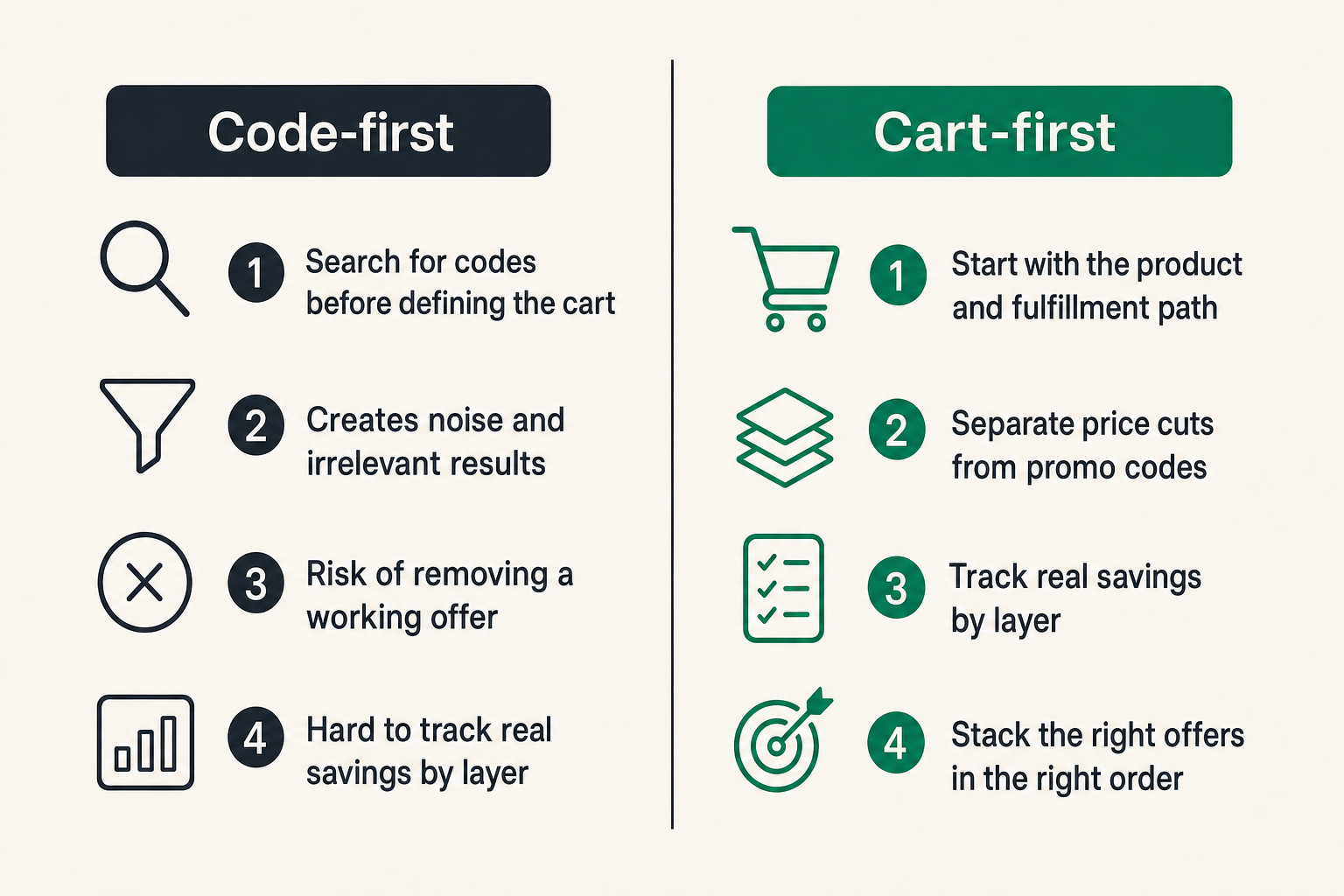
The mistake shoppers make is searching for codes before they define the cart. That creates noise. You end up testing codes that were never relevant to your order.
Start with the item, size, color, quantity, delivery method, and urgency. If you need youth soccer cleats by Saturday, store pickup may beat a larger online-only discount that arrives next week. If you are buying heavy fitness equipment, shipping cost can dominate the coupon. If you are buying apparel, clearance and seasonal sales may matter more than a generic promo code.
A good discount stack begins with the purchase constraint, not the coupon search.
Separate price cuts from promo codes
There are several kinds of savings, and they do not behave the same way:
- Markdown: the item price is already reduced.
- Coupon code: a code applies at checkout.
- Automatic promo: the cart receives a discount without a code.
- Rewards benefit: member points or account perks reduce future or current cost.
- Shipping discount: delivery cost changes based on threshold or method.
- Payment offer: a card, wallet, or cashback offer applies outside the store checkout.
If you combine those into one vague idea called discount, you lose visibility. You need to know which layer is doing the work. Otherwise, you may remove a working offer while testing a worse one.
Track rewards, gift cards, and shipping
Rewards, gift cards, and shipping are where many carts quietly win or lose. A code may save $10, but switching from shipping to pickup might save more. A discounted gift card may reduce effective cost even when no promo code applies. A rewards certificate may be better saved for a full-price item if your current cart is already on sale.
Practical rule: Build the stack in layers: product price first, then promo code, then rewards, then shipping, then payment or gift card savings.
This is why checkout architecture matters even for shoppers. The UI is not the whole system. State, eligibility, and final settlement are the real work.
Where to find a DICK'S Sporting Goods coupon code without wasting time
Use store pages and community submissions
Start with sources that give you context, not just strings of text. A plain list of codes without dates, notes, or shopper feedback forces you to do all the validation yourself. Community submissions are useful because they often include signals like recently tested, worked on apparel, excluded sale items, or failed at checkout.
For broader store discovery, you can browse coupon pages for many retailers through c0upons store listings and compare how active a store is before you spend time testing offers.
The practical question is not whether a code exists. It is whether other shoppers have seen it work recently under conditions close to your cart.
Check email, SMS, and app offers
Retailers often reserve some offers for logged-in users, email subscribers, SMS subscribers, or app sessions. Those offers may not appear on generic coupon lists because they are personalized, single-use, or tied to account behavior.
Do not overcomplicate this. Check your email, app notifications, and account dashboard before you run a public code hunt. If you have a member reward or targeted discount, it may be more reliable than a public promo code that has been scraped across dozens of websites.
Search with filters, not hope
Search works when you ask specific questions. Search fails when you paste every code into checkout with no plan. Try searching by store, category, and deal type. For example: footwear coupon, pickup discount, free shipping, clearance promo, golf sale, or team sports deal.
You can also use coupon search on c0upons when you want to check community-submitted codes across stores instead of opening a pile of random pages.
Related reading from our network: how to sell digital products is about merchants, but the checkout lesson is relevant for shoppers too: the offer is only one part of a working purchase flow.
Validate a DICK'S Sporting Goods coupon code at checkout
Test one variable at a time
When a code fails, shoppers often change three things at once: they swap products, change shipping, add another code, and log into a different account. Now they cannot tell what caused the result.
Test like this instead:
- Add the exact item or items you want.
- Choose the intended fulfillment method.
- Record the cart subtotal, shipping, tax estimate, and total.
- Apply one DICK'S Sporting Goods coupon code.
- Record what changed.
- Remove the code before testing the next one.
That sequence sounds slow, but it is faster than guessing. It also protects you from false positives where a sale price was already applied before the code did anything.
Watch exclusions and category rules
Most frustrating coupon failures are not random. They are rule mismatches. Common rule patterns include minimum spend, excluded brands, clearance exclusions, category limits, one-use codes, account-only offers, and channel-specific promos.
For sports gear, brand and category exclusions matter a lot. Footwear, golf, premium equipment, licensed fan gear, and fitness machines may have different promo eligibility than basic apparel. If the code headline says sitewide, still verify the cart. Sitewide often has fine print.
Practical rule: If a code fails, do not keep re-entering it. Change the cart condition you are testing, or move on.
Compare the final payable total
A code that applies is not automatically the best deal. You need to compare totals after all practical costs. Include shipping, taxes, pickup savings, rewards used, and any payment offer you plan to use.
Example: a 15 percent coupon may beat a $10 coupon on a large order. But if the 15 percent code removes free shipping eligibility or blocks a better automatic promotion, the smaller code may win. The final payable total decides.
A small scratchpad is enough:
- Baseline total: no code.
- Code A total: with shipping and tax.
- Code B total: with shipping and tax.
- Pickup total: if available.
- Reward or gift card impact: separate from store discount.
Stacking rules that matter for sports retail
Sale price plus code
The best outcome is usually a code that applies on top of a sale price. The problem is that many retailers restrict extra discounts on already marked-down items. That does not mean you should ignore sale items. It means you should test them differently.
If your cart is mostly clearance or seasonal markdowns, prioritize free shipping, pickup, rewards, or gift card savings. If your cart is mostly full-price apparel, a percentage code may have more room to work.
Rewards and account benefits
Member rewards can be powerful, but they are not the same as coupon codes. Some reduce current checkout cost. Some earn value for later. Some require login. Some may be tied to spending thresholds or certificates.
The practical question is whether using a reward now improves the total enough to justify burning it. If you have a reward that applies broadly, it may be better used on a future cart where public coupons are weak. If it expires soon, the calculus changes.
Gift cards, cashback, and payment offers
Gift cards and payment offers sit outside the coupon box, so shoppers often forget them. They can matter. A discounted gift card changes your effective cost. A card-linked offer may return value after purchase. Cashback portals can add another layer, but they may have exclusions and tracking risk.
Keep these layers separate in your notes. Do not call a cashback offer a coupon discount. It may post later, fail to track, or exclude certain categories. Treat it as potential additional value, not guaranteed checkout savings.
Related reading from our network: secure messaging apps architecture guide is obviously a different niche, but the same operator lesson applies: trust depends on clear boundaries, not just a nice interface.
A practical 2026 workflow for deal hunters
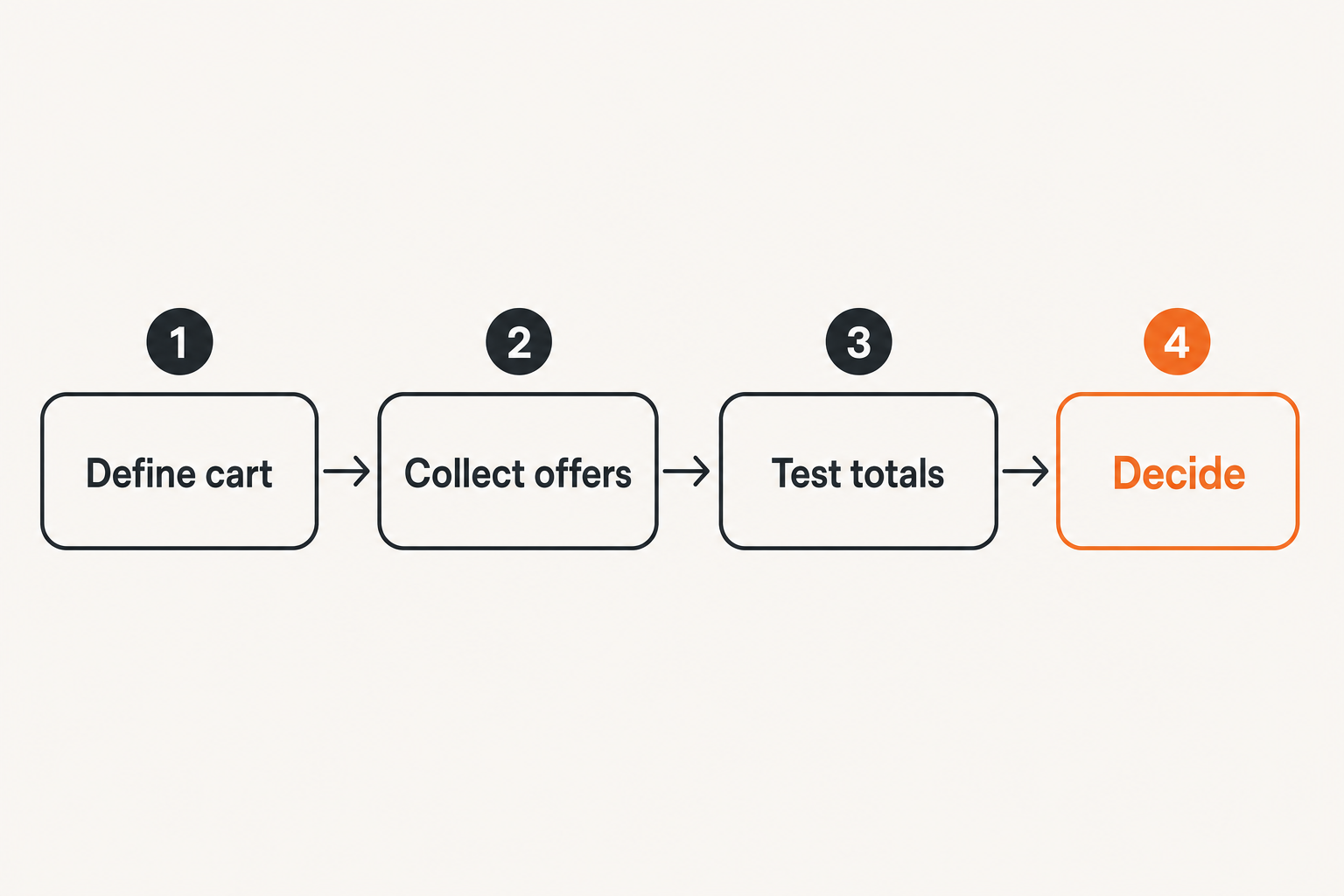
Step 1: define the cart
Write down the item, size, color, quantity, and fulfillment preference before you search. This prevents coupon drift, where a shopper starts with one goal and ends up adding filler items just to trigger a code.
Filler can make sense if it unlocks meaningful savings on something you already need. It fails when you spend $25 to save $10. That is not a deal. That is a checkout trap.
Step 2: collect candidate offers
Collect a small set of candidate offers, not every code on the internet. A reasonable batch is three to five:
- One public DICK'S Sporting Goods coupon code.
- One email or app offer, if available.
- One free shipping or pickup option.
- One rewards certificate or account benefit.
- One payment, cashback, or gift card layer.
This keeps the test controlled. You are trying to find the best total, not prove every code wrong.
Step 3: test and record results
Use a simple sequence:
- Log in if the offer requires your account.
- Confirm the cart is stable.
- Apply the first code.
- Record discount amount and total.
- Remove it fully.
- Apply the next code.
- Compare against baseline.
If the site auto-applies a promotion, record that too. Auto-promos can conflict with manual coupon codes. Sometimes the store has already given you the best available offer and the manual code adds nothing.
Step 4: decide, wait, or swap
After testing, you have three choices. Buy now, wait for a better sale window, or swap the cart. Swapping means changing size, color, delivery method, or product category to qualify for a better offer.
Waiting is rational when the item is not urgent and seasonal timing favors you. Sports retail has predictable cycles: back-to-school, spring training, holiday fitness, golf season, and end-of-season clearance. But waiting has inventory risk. If the size or color matters, the best theoretical future coupon may not help.
What breaks when coupon codes are used badly
Expired codes create false hope
Expired codes waste time because they look actionable. They create a false sense that a better deal is available if you just keep trying. That is the trap.
A good coupon workflow has an exit condition. If a code fails cleanly and no source suggests it worked recently, stop testing it. Do not let one dead code define the session.
Browser extensions can hide decisions
Browser extensions can be useful, but they can also turn checkout into a black box. If an extension tries ten codes automatically, you may not know which code changed the total, whether it removed another offer, or whether the final discount is actually best.
The mistake shoppers make is outsourcing judgment. Automation can test candidates, but you still need to verify the final total. If the extension finds a code, note it, then compare it against your own best stack.
Partial discounts can be worse than no discount
A code may apply to one item in a multi-item cart and ignore the rest. That is not necessarily bad, but it can mislead you. You might see a discount line and assume the whole order is discounted.
Check item-level savings when possible. If a $12 discount applies only to socks while your expensive footwear is excluded, another offer may be better. What breaks in practice is treating any discount line as proof of the best discount.
What works and what fails
What works in practice
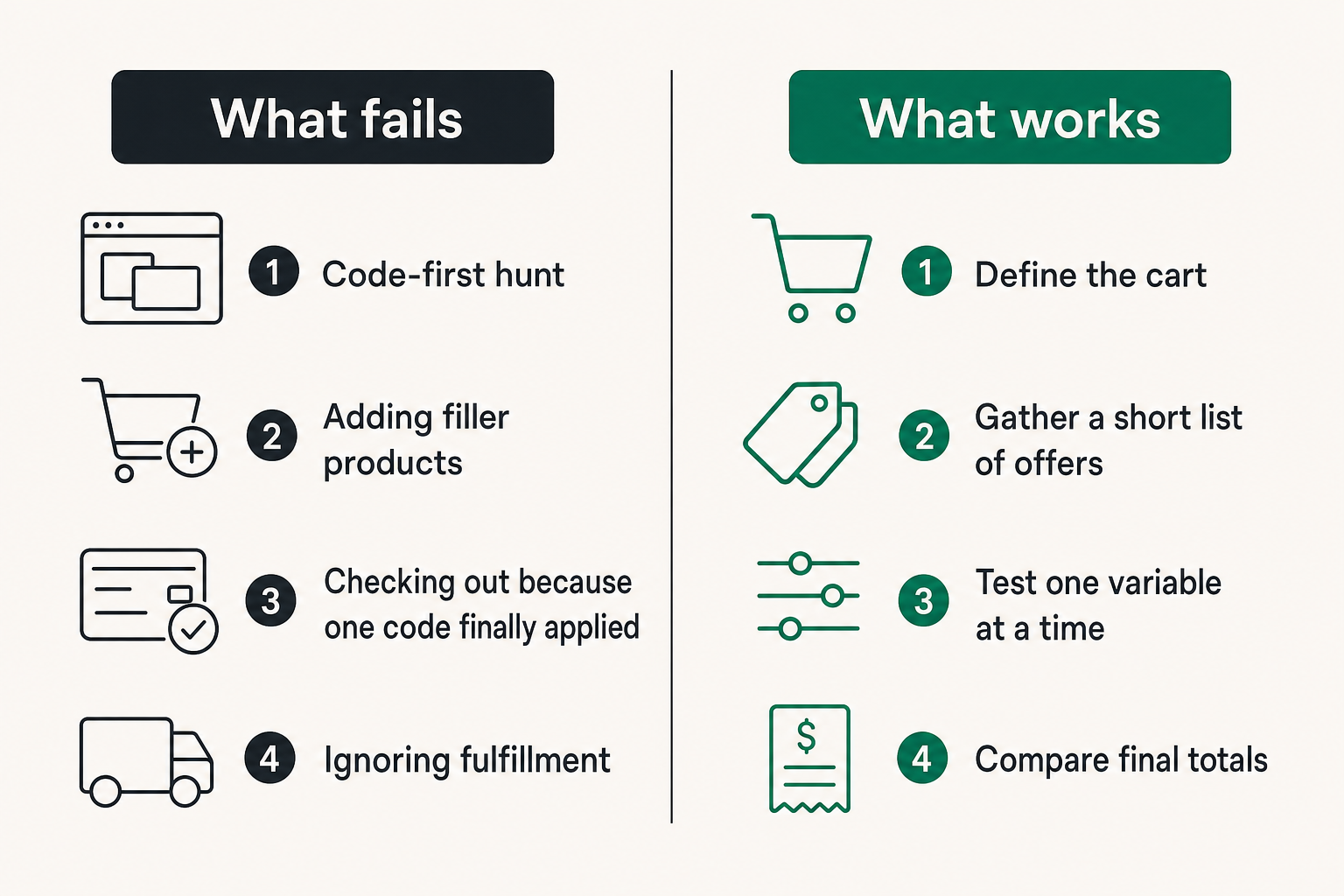
What works is boring and repeatable. Define the cart. Gather a short list of offers. Test one variable at a time. Compare final totals. Keep notes on what failed. Use community feedback to avoid stale codes.
This approach is not about being obsessive. It is about avoiding fake savings. If you shop sporting goods a few times a year, a clean workflow can save more than frantic last-minute code hunting.
What fails in practice
What fails is the code-first hunt. That looks like opening ten tabs, copying every code, changing the cart repeatedly, adding filler products, and checking out because one code finally applied. Many shoppers spend more this way.
Another failure mode is ignoring fulfillment. A code may look better until shipping appears. A pickup order may look worse until you remove delivery cost. If you do not compare the full payable total, you are not comparing real deals.
A simple decision table
| Situation | What to test first | What usually fails | Better move |
|---|---|---|---|
| Full-price apparel | Percentage coupon | Random free shipping code | Compare percentage code against account offer |
| Clearance footwear | Pickup or rewards | Sitewide promo with exclusions | Check sale price plus fulfillment savings |
| Heavy fitness gear | Shipping and delivery fees | Small percent code | Compare pickup, freight, and payment offers |
| Multi-item team sports cart | Category-specific codes | One code for everything | Split cart if savings justify it |
| Near minimum threshold | Add needed item only | Filler spending | Buy only if added item has real use |
Practical rule: If the discount requires you to buy something you do not need, count that extra spend against the deal.
Edge cases: pickup, oversized gear, and returns
Store pickup versus shipping
Store pickup can change the savings equation. It may remove shipping cost, speed up fulfillment, and preserve inventory for local items. It may also limit which promos apply. The only way to know is to test both paths when both are realistic.
For urgent purchases, pickup often wins even without the largest coupon. If your kid needs cleats for a weekend tournament, the cheapest shipped total arriving next week is not the best operational outcome.
Team sports and excluded brands
Team sports carts are tricky because they often mix equipment, apparel, footwear, and accessories. A DICK'S Sporting Goods coupon code may apply to one category but not another. Excluded brands can also create uneven results.
If the cart is large, consider testing whether splitting the order helps. Sometimes one code works on apparel while another offer is better for equipment. Do not split automatically, because shipping and pickup complexity can erase the benefit. Test the total.
Returns, exchanges, and adjusted refunds
Returns can change the effective discount. If a coupon applied across a cart and you return one item, the refund may be adjusted. If you used rewards or gift cards, the return path may not behave like a normal card refund.
Before buying multiple sizes with the plan to return extras, check how the discount affects refund value. The best checkout total is not always the best final outcome if the order has a high chance of returns.
Use c0upons.com as a savings workflow, not a last click
Search, store pages, compare, submit
c0upons.com is most useful when you treat it as part of the workflow, not a panic button at the coupon box. Use it to search for active offers, compare store patterns, and see whether community notes match your cart.
If you find a working code, submit it back when you can. Community coupon systems improve when shoppers report what actually happened: worked on apparel, failed on clearance, required login, expired, or only applied above a threshold. That context saves the next shopper time.
Community notes beat mystery codes
A mystery code with a huge headline is less valuable than a smaller offer with clear notes. The best coupon communities reduce uncertainty. They do not promise that every code will work. They help shoppers test faster and avoid obvious dead ends.
That is the practical architecture for deal hunting in 2026: search, validate, compare, and share feedback. Before you apply the next DICK'S Sporting Goods coupon code, build the cart, test the stack, and let the checkout total prove the savings.
Try c0upons.com
c0upons.com helps online shoppers find practical ways to save money with coupon codes, promo codes, sales, and deal roundups. Use it before your next DICK'S Sporting Goods coupon code test. Try c0upons.com